Hong Kong and Macau
Teaching a Course in Hong Kong, and Visiting Macau
I had gone to Hong Kong to teach a one-week course, the first time on networking protocols for a major U.S. telecommunications company, the second time on cybersecurity. I had arrived on a long flight from the U.S. and looked around Hong Kong a little. Now it was time to set up and teach the course. Over a weekend I would make a quick visit to Macau.
The day after I arrived in Hong Kong for the first time, finally feeling a little more human, I called the local representative of the training company to let him know I was in Hong Kong. I would be ready to teach the course when it started in a few days. He was startled to learn that I had actually stayed at the Chungking Mansions. He had assumed that it was a joke and an idle threat when I had mentioned it on the phone while planning my trip.
It was strange. He claimed to be from New Zealand but he had lived several years in Hong Kong without even crossing the border to Guangzhou. Given how many Kiwis I've run into in other parts of the world, I came to suspect that he wasn't really from New Zealand.
The classes I taught were, well, a bit odd. The public course, an introduction to cybersecurity, went pretty well. It was about like teaching the same one-week short course in the U.S., although with a bit less interaction from the students.
The on-site TCP/IP course for the U.S. telecommunications firm was the stranger one, in some ways one of the oddest course weeks I've had. It was a hands-on course, with lecture time interspersed with labs using Ethernet switches and routers, packet sniffing software, and the operating system command-line interface.
One guy only showed up for about an hour a day, and pretty much got nothing at all from the course. He wandered in about 1600 on Friday, only seven hours late, and seemed shocked that the course was over and most of the hardware was in shipping cases.
The course builds on prior material through the week, so I would always wait for half of them to get there before starting the class each day. But that meant we couldn't start before 0930 any day, despite the company's prior announcement, and mine on the first day, that it would start at 0900.
Most all of them wandered in and out throughout the week, and many would take (or place!) eight to ten mobile phone calls during each class day. Meanwhile they asked very few questions and made almost no comments. An extremely quiet group in the class, but extremely chatty on their mobile phones. Oh well, it was their money.
The thing is, these two courses were in 1999 and 2001. At that time, that wasteful and rude behavior seemed odd to me. I was accustomed to teaching courses in the U.S., where mobile phone use was far lower. Since then, U.S. groups, especially Washington-area employees of the U.S. government and its contractors, are now at least as self-distracted and inattentive in classes.
A manager was in the class for reasons I couldn't determine. He would ask for a detailed explanation of a complex topic — "Could you list the specific advantages of the OSPF routing protocol, and compare it to the Cisco proprietary routing protocols?" — and then walk out of the room as I started to respond. I assumed that he did this to ensure that I explained certain things to his employees. So I asked him at a break if he could give me a list of those topics. That way I could prepare something a little more organized and make sure that they came up at relevant times (his questions were pretty erratic, asking about routing protocols when we were discussing Ethernet signaling and vice-versa).
He told me that it wasn't for his employees. They didn't do anything with the specific technology he was asking about. He was just personally curious.
Oh.
Well, I did answer his questions in detail, but he was always out of the room the entire time and so he missed the explanations.
He gave me the look you give someone who is patiently explaining that the sun goes down at night and then it gets dark, and said that didn't matter at all — I should answer his questions in great detail because he could ask his employees for the detailed explanation later if he decided that he still wanted it.
Bizarre.
The public course, the introduction to information security, went much better. I think the strangeness of the networking course was mostly due to an odd corporate culture. The infosec course had the usual mix — a couple of people from prominent Hong Kong banks, two from a technology company, and eight from ITSD, the Hong Kong city government information technology group.
However, the training company I was working for quit teaching courses in Hong Kong two years or so after my second trip there. They offered some strange excuses, saying at times that it was because worry about SARS largely shut down travel to and from that region for a few months, and at other times that it was because an instructor who was there teaching a course had been struck and killed by one of the double-decker trolleys.
I eventually learned that it was because they had realized that they never taught the same public course twice. There was always at least one person in the course who was there primarily to buy a copy of the notebook. Local training companies would bootleg the course by photocopying the notebooks. They would offer the same course under the same title, possibly even advertising it as the original company's course. No, there would be no hands-on exercises, but they would point out how much cheaper it was this way.
Macau
Toward the end of one of the trips I went to Macau for the day. It's just a 50-minute ride on a jet catamaran from Hong Kong. Tickets are pretty cheap. Let's see how to get there.
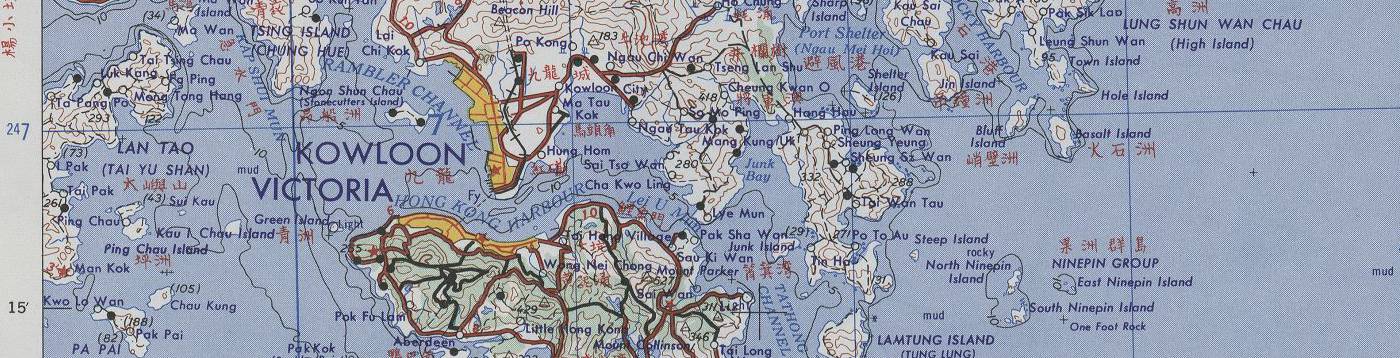
First, the big picture. There are ferry docks on both sides of the Hong Kong harbor between Hong Kong Island and the Kowloon peninsula. The ferry will run southwest, passing to the south of the large Lantau island, then almost straight west to Macau.
Crossing the open water, out of sight of land, it was still very noticeable that the water was very brown. Lots of pollution and sediments flow out of the Pearl River delta.
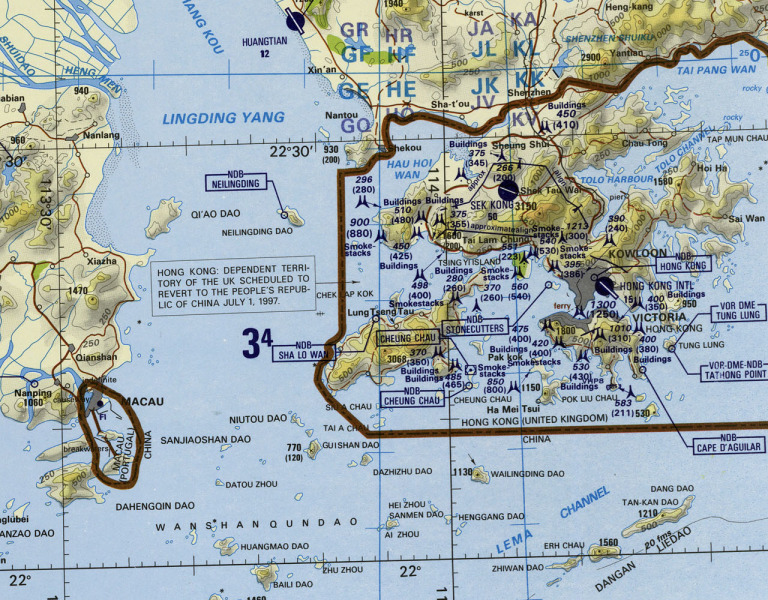
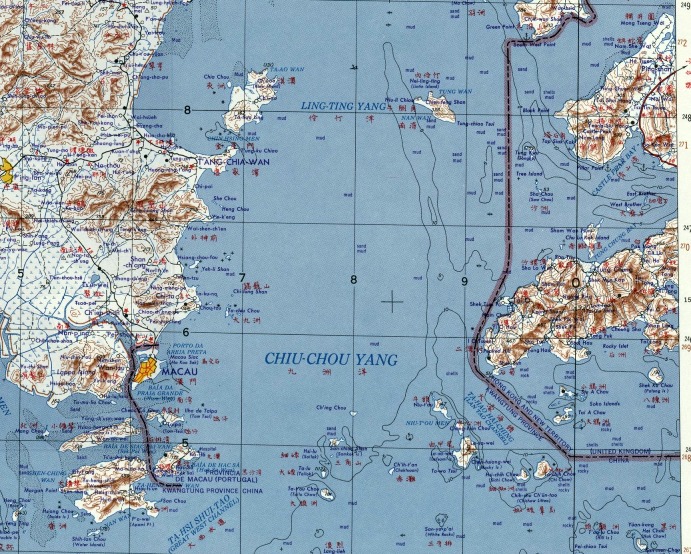
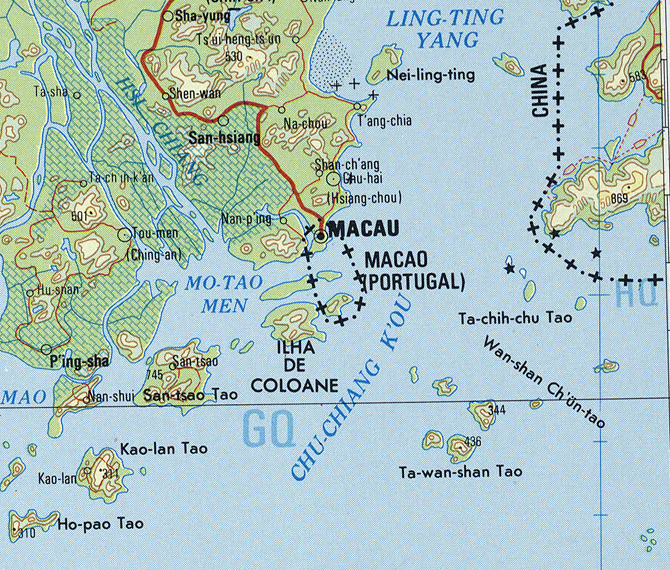
Macau is tiny. The main settlement is the tip of a peninsula being extended by landfill. The economy is mostly based on the local extremely tacky version of gambling.
Well, let's face it. Unless you're in Monaco, or Baden-Baden, or inside a James Bond novel or movie, all gambling is tacky.
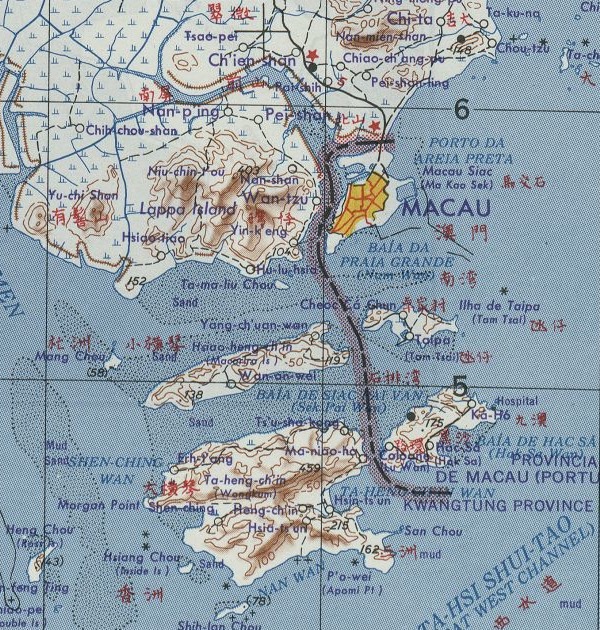
As you can see by comparing the above map and this next one, Macau's very limited space is expanding through landfill.
Gambling in Macau is tightly connected with the Triads, the Chinese criminal gangs. Another shady alleged connection is to Nazi gold, a theory used to explain why China allowed Portugal to administer Macau for so long, and the close connection between China and Macau through that period. From Lonely Planet:
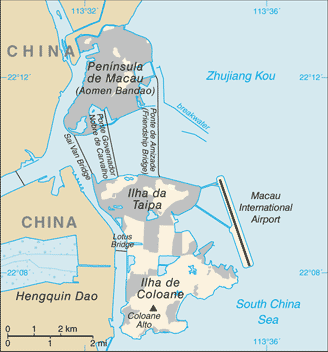
U.S. Government map of Macao.
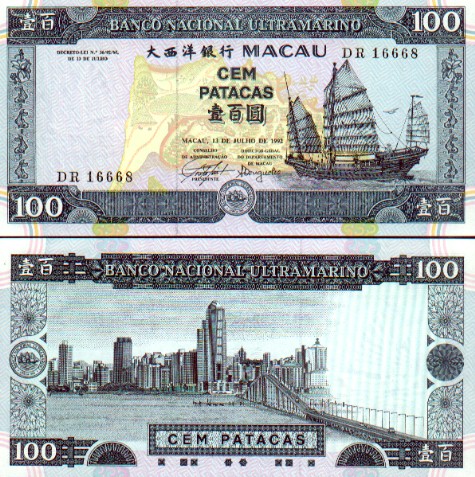
Front and rear of a 100 Macanese Pataca (MOP). MOP$ 1 is divided into 10 ho or 100 avos. As with Hong Kong currency, there are two series — one issued by the Banco Nacional Ultramarino and one by the Bank of China. But most of the currency in circulation in Macao is Hong Kong Dollars.
Macau was interesting and more pleasant than Hong Kong or Guangzhou. It's an odd mix of Portuguese and Chinese backgrounds.
The buildings are mostly of a vaguely European style. There are lots of signs in Portuguese, so it's relatively easy to get around. Not that I can read Portuguese, but at least I can deal with the character set. And Portuguese looks sort of like horribly misspelled Spanish, so any Tourist Spanish helps. The local food specialty is African spicy chicken, brought here from another Portuguese colony.
The A-Ma Temple is a Buddhist complex of several shrines built into a steep hill. Its present buildings date back to the 1600s.
Macau has lots more churches than Hong Kong, due to the Portuguese background. And only Saudi Arabia would have fewer than mainland China.
The classic Macau sight is the Ruinas de São Paulo, described in the Lonely Planet as "the greatest monument to Christianity in the east" and the symbol of Macau. It's just the facade, all that remains of a Portuguese church from the early 1600s.
I was there on Saturday, 19 December 1999, during my visit to Hong Kong. The next night at midnight, Macau was handed over to the Beijing government. TV crews were already setting up to cover the event, the end of the last European colony in Asia.