Ephesus
Ephesus / Efes / Έφεσος
Ephesus was one of the great cities of the Ionian Greeks in Asia Minor, the region called Anatolia by the Greeks. It was located in the Greek nation-state of Lydia, where the Cayster River flowed into a natural harbor extending several kilometers to the Aegean Sea. The locals, of course, knew it as Έφεσος. Under Roman rule Ephesus became the second largest city of the Roman Empire, and in the 1st century BC it was the second largest city in the world.
Today, Ephesus is a collection of ruins just a couple of kilometers west of Selçuk, a small town about an hour by bus south of İzmir. The locals call the ancient city Efes.
The area was inhabited back into the Neolithic or New Stone Age, and a sizeable settlement grew up here in the early Bronze Age. The center of settlement moved around throughout prehistory and through the historic times, as the river changed its course in this flat valley and the location of the natural harbor moved and finally disappeared.
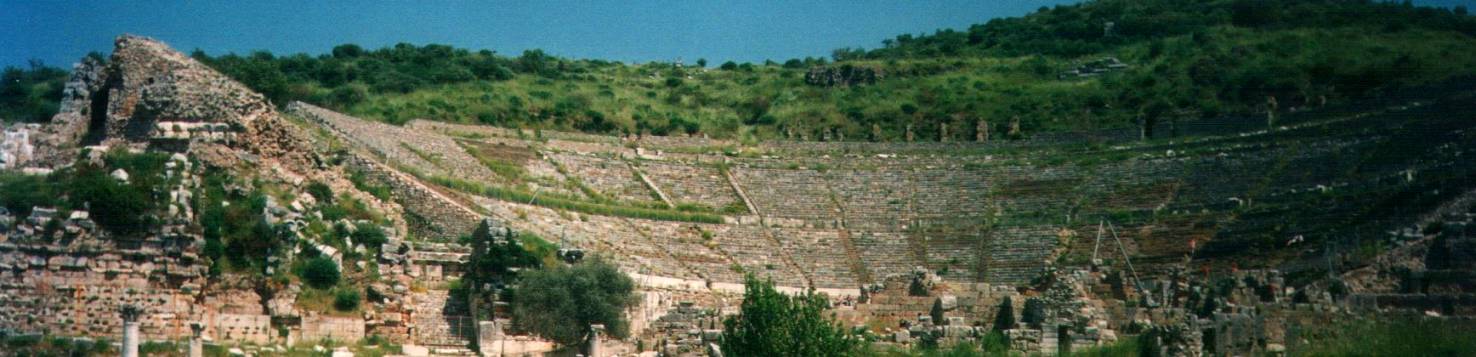
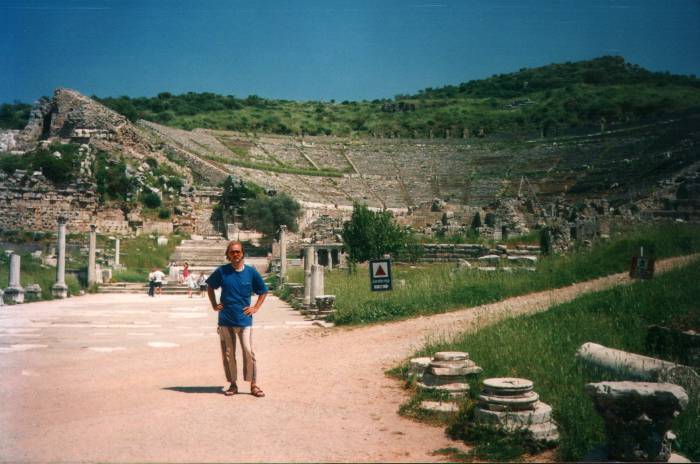
The Great Theatre in Ephesus looks over the harbor district toward the Aegean.
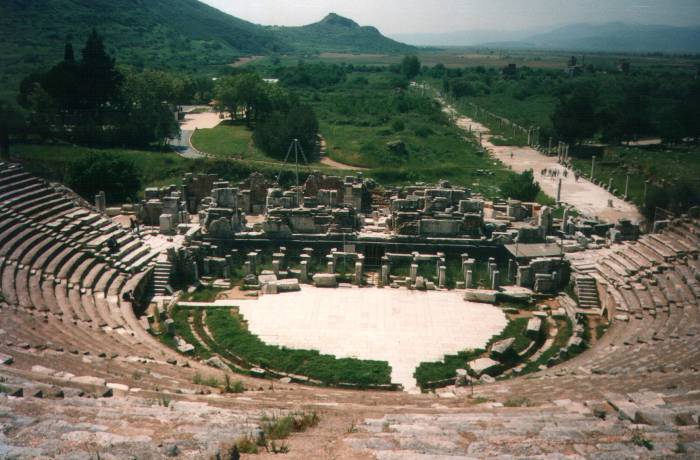
The small hill in the distance in the above picture has a small Byzantine era fort on top. From there you have a nice view of the site of the harbor (just beyond the Harbor Street seen leading away above), and in the other direction, to the Aegean coast.
The following timeline describes the history of Ephesus. Below that are lots more pictures!
History of Ephesus
Prehistoric times through the Neolithic Age
The excellent location was settled early. The area was settled during around 6000 BC during the Neolithic Age as shown by the nearby hoyuklar, or artificial mounds or tells near Arvalya and Cukurici.
Early worship of the Mother Goddess of west Asia begins. See the page on the Temple of Artemis, the later temple dedicated to a combination of the Greek and Roman deity with this local West Asian Mother Goddess in this truly Old-Time Religion.
Early Bronze Age — Mycenaean era
Mycenaean era pottery has been found at Ephesus, and a burial ground from 1500-1400 BC was discovered on Ayasuluk Hill near the ruins of the Basilica of Saint John.
Mycenaea, in the Peloponnese just south of Korinthos, was the opposing side in the Trojan War. And yes, Troy is also in Turkey, up the coast near Canakkale, where the water from the Black Sea has made its way down the Bosphorus, into the Sea of Marmara, and then down the Hellespont ("Greek Bridge") into the Aegean.
The Mycenaeans, or the Achaioi (or Άχαοι as Homer called them), were expanding from the Mycenaean homeland in the Peloponnese of southern Greese.
Ephesus is believed by many researchers to be the Apasa (or Abasa) that the Hittites described as the capital of the kingdom of Arzawa or Ahhiyawa. See the page on Hatuşaş, the Hittite capital in north-central Turkey, for more on the Hittites.
Ephesus was founded as an Attic-Ionian colony in the 10th century BC on Ayasuluk Hill above modern Selçuk and three kilometers from the ruins of Ephesus seen today. It was attacked and sacked by the Cimmerians around 650 BC.
The Lydians under King Croesus conquered the city around 560 BC.
Persian rule
Later in the 500s BC the Lydians under the rule of King Croesus invaded Persia. The Lydians in Ephesus sided with Croesus and Lydia. When the Persians defeated Croesus' Lydians, they insisted that the Ionians surrender and join the Persian Empire. The Greek cities of Asia Minor were incorporated into the Achaemenid Empire of Persia, and ruled by Persian Satraps.
Classic Greece
Alexander the Great passed through Ephesus at the beginning of his conquests. He had just defeated the Persian forces at the Battle of Granicus in 334 BC, liberating the Greek cities of Asia Minor. He saw that the Temple of Artemis was not yet finished being reconstructed after a recent catastrophic fire, and he suggested that he finance its reconstruction and have his name added to its front. The wise Ephesians knew how to talk him out of this, by saying that it was not fitting for one god to build a temple to another.
The ruins of Ephesus seen today are of the city rebuilt in 290 BC by Lysimachus, one of Alexander's generals who divided up rule of his empire after his death.
Ephesus became known as "The first and greatest metropolis of Asia." It was famous for its:
- Temple of Artemis — said to be the largest building of the ancient world (according to Pausanias), and one of the Seven Wonders of the ancient world (according to Antipater of Sidon, who compiled the original list, and much later by Philo of Byzantium, who further popularized the idea).
- Great theatre, which could seat 25,000. And it is still used for concerts by the likes of Sting, Pavarotti, etc. But no gladiatorial combat, that was strictly a Roman thing...
- A significant library and center of learning.
- Lots of businesses, smaller theatres, and more.
Lysimachus was killed in 281 BC, leading to the town being absorbed into the Seleucid Empire. Then Ptolomy III, descendant of Alexander's general who seized control of Egypt, came along the coast of Asia Minor seizing land. Ephesus was ruled from Egypt 263-197 BC.
The Battle of Magnesia in 190 BC gave control to the kingdom of Pergamun, from which it passed to Roman control around 100 BC.
Roman Ephesus
When Rome took over the Greek lands in addition to much of the rest of western Asia, Ephesus became the proconsular capital of western Asia Minor. Ephesus grew in size and importance. The four major cities of the Roman Empire became:
- Rome (obviously!)
- Ephesus
- Antioch (also in Turkey, near the Syrian border on the Mediterranean coast — called Antakya today)
- Alexandria (in Egypt at the edge of the Nile delta)
The population of Ephesus had reached 250,000 in the 1st century BC, and by 100 CE, the population had grown to an estimated 400,000 to 500,000, making it the second largest city in the world after Rome.
The Romans added their own style of infrastructure — many aqueducts for water supply, public baths, and one of the earliest sewage systems. Click here to see the public toilets!
Early Christianity
The apostle John came to Ephesus soon after 33 CE, and lived there the rest of his life. A prominent theory is that John brought Jesus' mother Mary with him, because he had been charged with taking care of her, and you couldn't very well take care of someone many hundreds of kilometers away in those days! See the page on Maryemana for what is thought to be Mary's home on a mountaintop above Ephesus.
Paul passed through here many times on his travels, as did the gospel writer and Greek physician and history writer Luke — see Luke's Acts of the Apostles for some local history (including a report of a riot in the Great Theatre), and Paul's Letter to the Ephesians for his letter to the community he had come to know. Paul wrote his first Letter to the Corinthians during one period when he was in Ephesus.
John's Revelation was written from the nearby island of Patmos, but it was addressed to seven churches in western Turkey — Ephesus was one of the seven. See the list further down this page for how over half of the New Testament has some connection to today's Turkey.
A major church building, the Basilica of the Virgin Mary, was built in Ephesus in the 300s.
The Third Ecumenical Council of 431 was held in this basilica. An ecumenical council was a major meeting to define church doctrine. Usually, as in this case, it was really called to stamp out what were seen as heresies, and in the process define someone (Nestorius in the council of 431) as a heretic.
In the 500s, under the Byzantine Emperor Justinian I, the enormous Basilica of Saint John was completed nearby. It was on a hill well outside the city, overlooking the former site of the Temple of Artemis, whose stones were re-used in its construction. The site overlooks what is now the town of Selçuk.
Post-Roman era
In 263 CE — late Roman times — Ephesus was sacked by those pesky and violent Goths.
However, the city rebuilt and moved on, and became the second-most important city in the Byzantine Empire through the 400s and 500s.
In 654-655, 700, and 716 the Arabs sacked the city, and earthquakes around that time changed the flow of the Cayster River (now known as the Küçük Menderes, or the "Little Menderes"). The harbor quickly disappeared as it filled with silt.
This confuses some visitors initially — Ephesus was a major sea port, but where is the sea? If you go up on the small hill seen in the distance in the above picture, where you find a small Byzantine-era fort, you are on a high spot between Ephesus and the present coastline. At certain times of the year, the area of the former river mouth and harbor are visible as a large area that is slightly greener because the soil has a little more moisture.
With the complete failure of the harbor and heavy damage to the city's buildings, the once-great city of Ephesus quickly faded away.
When the Seljuk Turks conquered the area in 1090, Ephesus was just a small village in the city ruins.
The Byzantines took the city back just ten years later, in 1100, and kept control until the late 1200s.
The Ottoman Turks then held the area, and Ephesus was completely abandoned in the 1400s.
Ephesus today
Up through the 1970s Ephesus was just a remote ruin known to historians, archaeologists, and the local people. In the past few decades, as international tourism has become more and more popular, Ephesus has been an increasingly popular destination.
Today the ruins have been largely restored, there is frequent bus and dolmuş service to Selçuk, and there are many nice guesthouses and hostels in Selçuk for visitors.
The Great Theatre
This is The Great Theatre, a view looking south from the far left seats. It could seat 25,000 back when the city of Ephesus was at its peak. After its partial restoration, now it is again used for concerts.
The original stage surface is missing. The array of square-topped columns supported the stage, and the space below could be used for special effects of the day. For example, gods rising out of the stage and appearing out of nowhere. That area could also serve as dressing and storage areas.
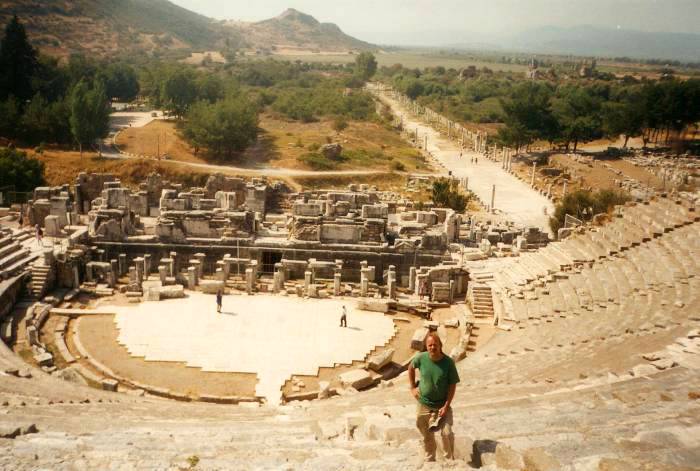
Ephesus was a major seaport, even though it is several kilometers from the Aegean Sea. Earthquakes greatly reduced the flow of the Cayster River, and the natural harbor silted up. The harbor was in what is now the open field beyond the trees in the picture above.
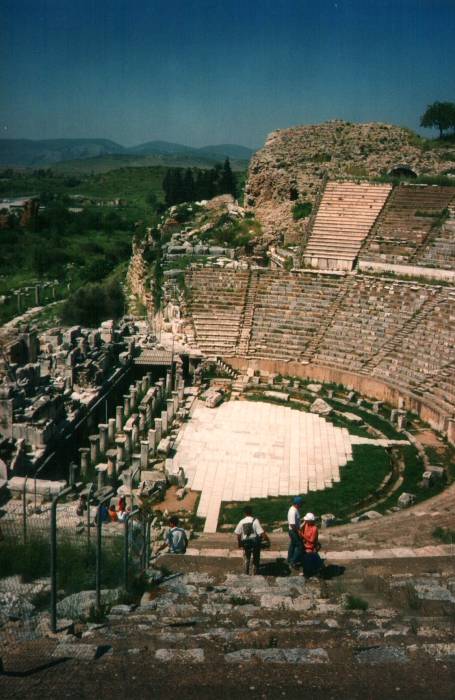
The broad street running off to the west from the theatre toward the seacoast is Harbor Street. One of three major boulevards running through the city, it used to lead to the nearby harbor.
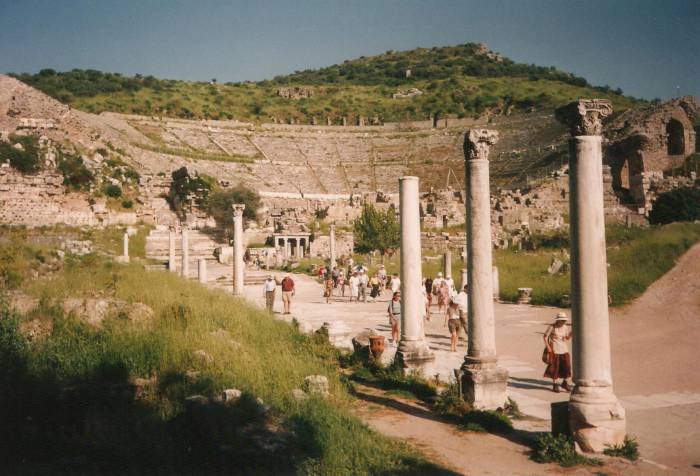
In the above we have gone down to the end of Harbor Street and we're looking back up toward the Great Theatre.
The Library of Celsus
The Library of Celsus was built around 125 BCE by Gaius Julius Aquila in memory of his father, Tiberius Julius Celsus Polemaeanus, who was commonly known as Celsus and held a number of Roman positions of power. This library was a significant center of study holding about 12,000 scrolls. It faces toward the east so the reading rooms could make the best use of the morning light.
The façade is about all that remains of the original structure, and it was rebuilt during the 1960s and 1970s by Austrian archaeologists.
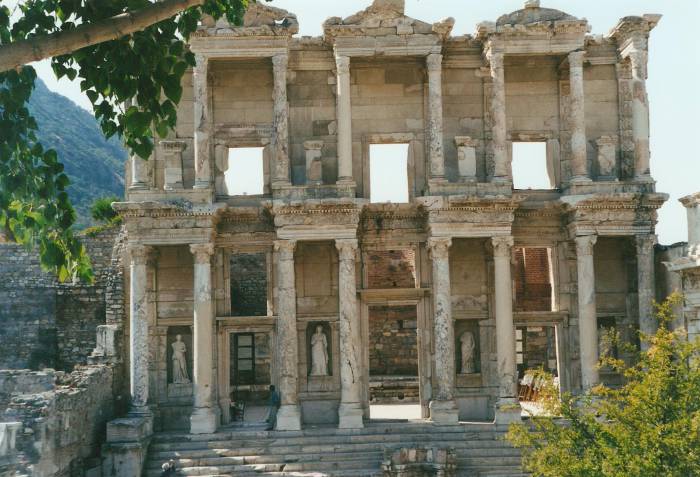
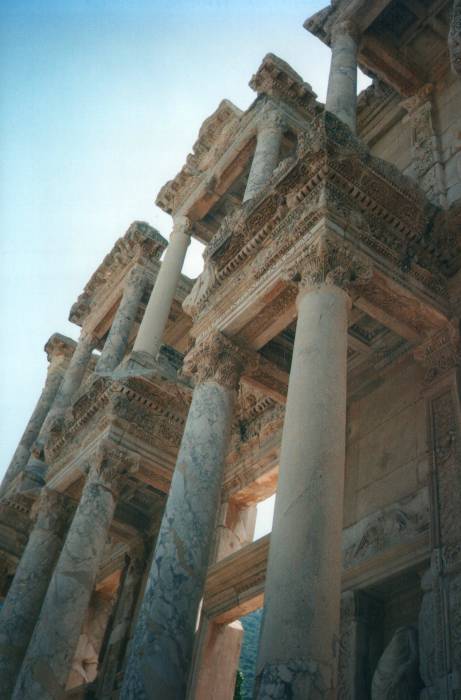
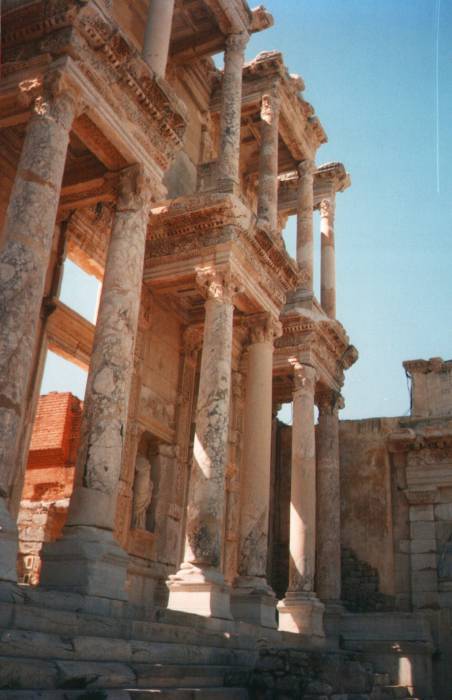
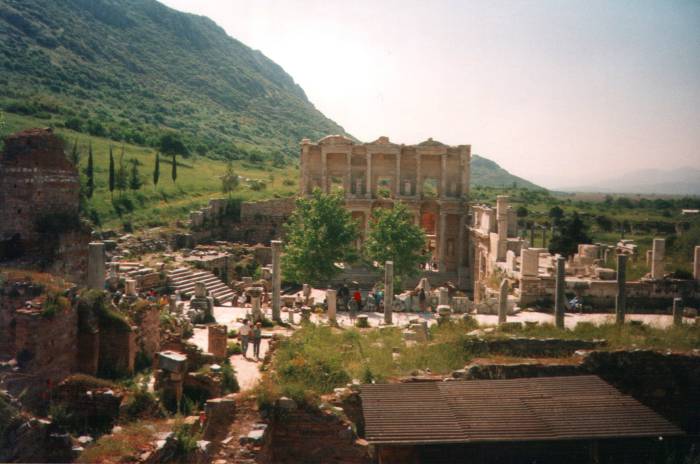
Like the Great Theatre, The Library of Celsus sits at one of the main intersections of the city. This view is toward the west, looking toward the area of the harbor and toward the sea.
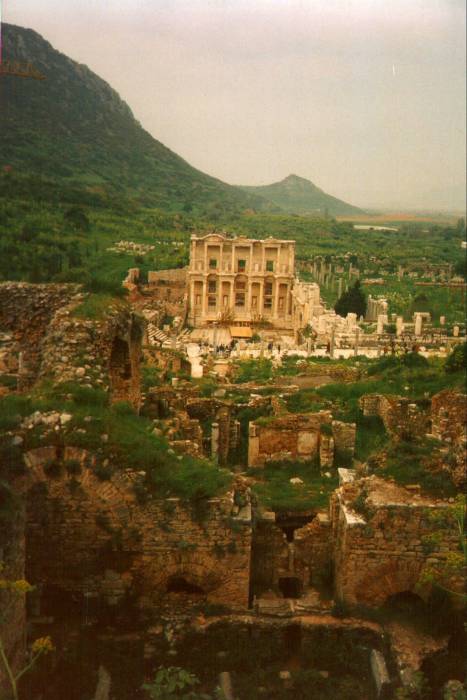
On a different day, after some rain, we have moved further up the hill. The especially lush green area beyond the Library and slightly to its right is the site of the old harbor. It silted in centuries ago, but it is still low ground that retains more moisture than the surrounding soil.
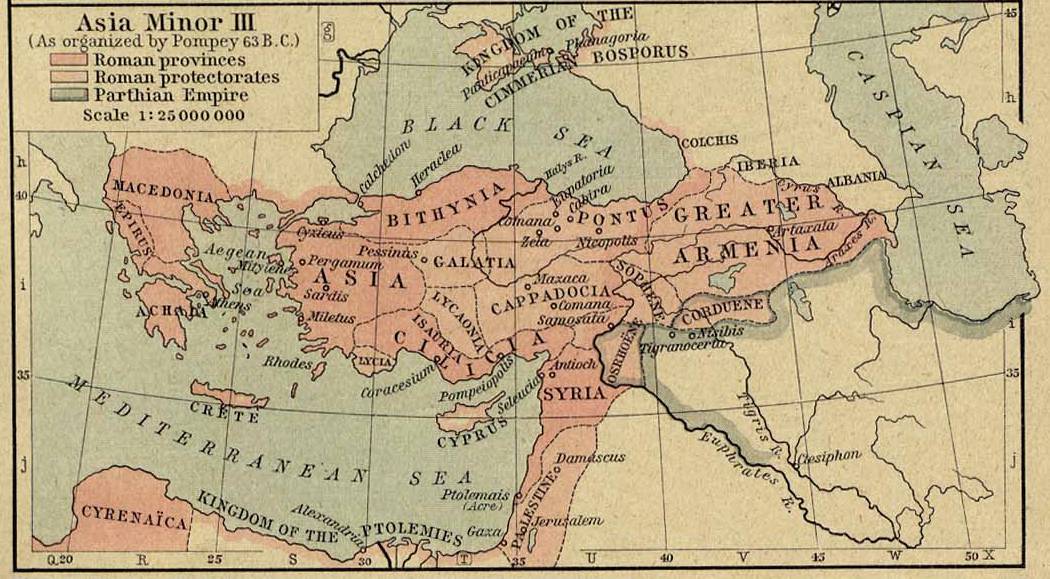
Antiochus III the Great or Άντίοχος Γ ο Μέγας ruled the Seleucid Empire in 222-187 BC, controlling Syria and large parts of the rest of western Asia. The Roman province of Asia was a large territory. He waged war against the Roman Republic in the autumn of 192 BC with a 10,000-man army, describing himself as "the chamption of Greek freedom against Roman domination."
However, the Romans soundly defeated Antiochus' army at Thermopylae, forcing him back into Anatolia which they then invaded. The 188 BC Treaty of Apamea gave all of Anatolia north of Όρη Ταύρον or the Tarsus Mountains to the Roman Republic.
Celsus was a native of the area, born either in Ephesus or Sardis, and he was one of the first men of purely Greek origin to become a consul in the Roman Empire. Really he was Τιβέριος Ιούλιος Κέλσος Πολεμαιανός, a Greek citizen of the Roman Empire who took Latin names.
69 AD was "The Year of the Four Emperors." Nero committed suicide in 68, and a brief civil war followed. Then from June 68 through July 69, Galba, Otho and Vitellius took power and fell, and then Vespasian, the first ruler of the Flavian Dynasty, seized power. Celsus or Κέλσος was in the Roman military at the time, and he and his Legion acclaimed Vespasian as the Emperor.
Vespasian remembered this, and once he stabilized his hold on power he raised Celsus to the senatorial class as a reward.
Celsus went on to become consul in 92, and in 105 the Emperor Trajan named Celsus proconsular governor of the Roman province of Asia.
Celsus is entombed in a sarcophagus buried in a crypt beneath the entry to the Library. It was unusual for someone to be buried within a city, and even more so for him to be buried in a library. I suppose this is a little like John Purdue being buried on the campus of Purdue University. If you fund an educational facility, you can be buried in it.
Celsus died around 120. The Library and all of its books were destroyed by fires that spread during the devastating earthquake of 262. The façade had survived the fire, and about 400 the library was converted into a Nymphaeum.
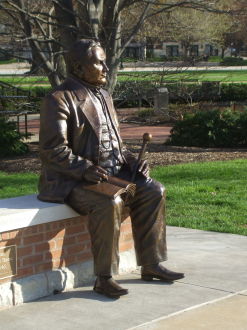
John Purdue's memorial statue is on the central mall of the Purdue campus. His grave marker is just beyond the statue.
The city center
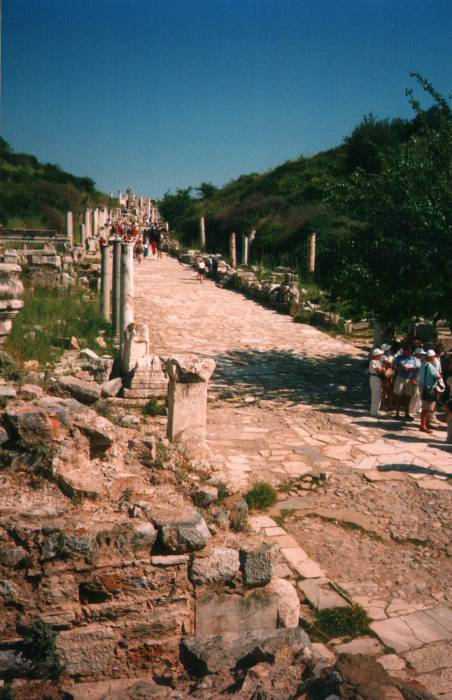
This view is looking the opposite direction, away from the Library of Celsus and up the hill along Curetes Way.
That major avenue went through the business district, past many other temples, smaller theatres, baths, the public toilets, and residential districts.
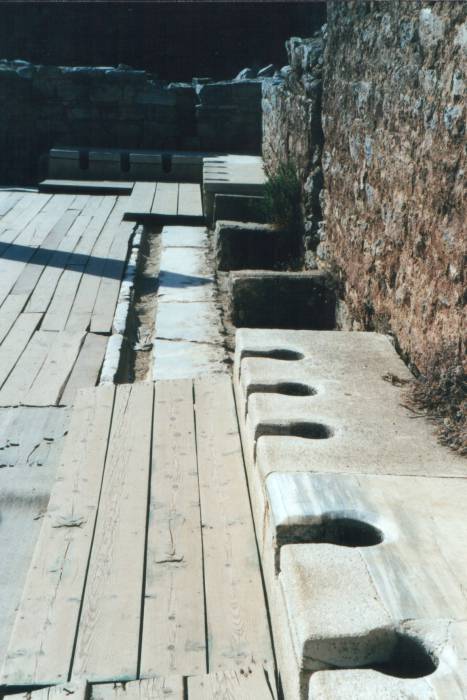
There was a large public latrine near the Library of Celsus. See my Toilets of the World site for details on the plumbing of the ancient world. Some of these pictures were included in De Samenleesbijbel, Read the Bible Together, a Dutch study Bible for children of 8–12 years.
Looking down Curetes Way, past Trajan's Fountain and the Temple of Hadrian toward the city center.
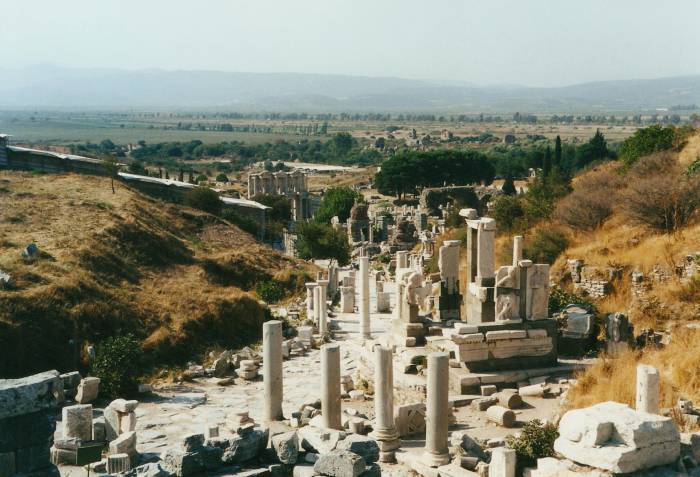
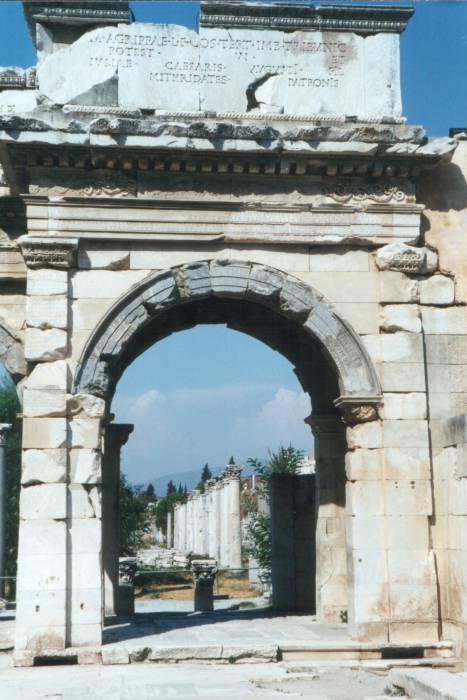
An arch leads west from the city center.
Cybele / Artemis
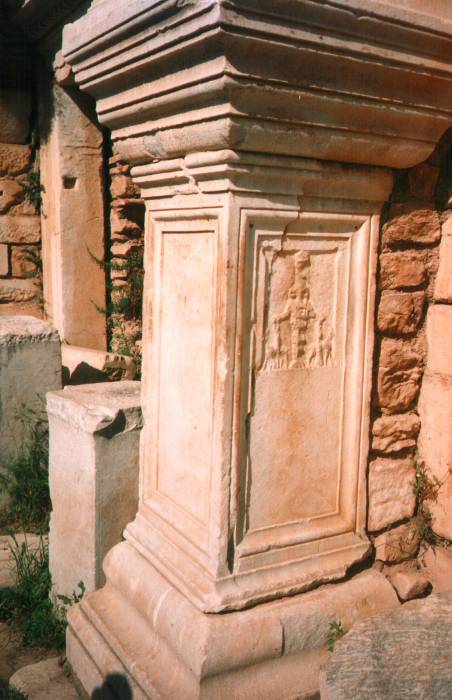
An architectural column in the city shows the uniquely Ephesian twist on the Greek goddess Artemis (or Αρτεμις).
Or looking at it more realistically, the Greeks arrived to find the locals worshiping the Anatolian Mother Goddess, known to the Phrygians as Cybele. The Greeks then did their usual thing and identified that local deity with whatever goddess of theirs seemed to be the closest.
In this case it wasn't very close — Artemis and Cybele or the Mother Goddess were very different.
There are some shrines to the Anatolian Mother Goddess on the way from Selçuk to Ephesus. See the page describing the walk from Selçuk to Ephesus for pictures of these Mother Goddess shrines.
Worship of the Mother Goddess dates back to Neolithic times. A figurine found at Çatal Höyük dates back to about 6000 BC.
Church history
| Book | Verses | About / from / to what is now Turkey? |
| Matthew | 1071 | Largely written from Antioch |
| Mark | 678 | |
| Luke | 1151 | |
| John | 879 | Written in Ephesus |
| Acts | 1007 | Largely set throughout what today is Turkey |
| Romans | 433 | |
| 1 Corinthians | 437 | Written in Ephesus |
| 2 Corinthians | 257 | |
| Galatians | 149 | Written to the people of Galatia |
| Ephesians | 155 | Written to the people of Ephesus |
| Philippians | 104 | |
| Colossians | 95 | Written to the people of Colossae |
| 1 Thessalonians | 89 | |
| 2 Thessalonians | 47 | |
| 1 Timothy | 113 | Written to the church in Ephesus |
| 2 Timothy | 83 | Written to the church in Ephesus |
| Titus | 46 | |
| Philimon | 25 | Written to a man in Colossae |
| Hebrews | 303 | |
| James | 108 | |
| 1 Peter | 105 | |
| 2 Peter | 61 | |
| 1 John | 105 | Written in Ephesus |
| 2 John | 13 | Written in Ephesus |
| 3 John | 14 | Written in Ephesus |
| Jude | 25 | |
| Revelation | 404 | Written to seven western Anatolian churches: Ephesus, Smyrna, Pergamum, Thyatira, Sardis, Philadelphia, and Laodicea |
Moving to a much newer religion, over half of the New Testament of the Bible was written:
- About events that took place in what is now Turkey, or
- To communities or individuals in what is now Turkey, or
- While the author was in what is now Turkey
Ignoring the difficulty of precise attribution of the texts,
the list is:
7957 verses total, of which 4550 (57%) were written about,
to, or from, what is now Turkey.
The Church of Mary or Meryem Kilisesi was located next to the harbor. It was initially built in the early 5th century, apparently built on the ruins of an earlier Roman building similar to a basilica and abandoned around the 3rd century. This large church may have been built specifically for the Third Ecumenical Council, also called the First Council of Ephesus, held here in 431 AD.
About 70 years after the council meeting, around the year 500, it was expanded into an larger cathedral.
In this picture we are standing near the entryway, looking up the length of the church. That row of white columns just beyond the man is less than a third of the way to the far end of the apse, barely visible in the distance as a pair of white columns with a small white sign between them.
The hill beyond the apse is the hill rising above the great theatre. We're looking toward the east, inland. As with Christian churches of the period, it is laid out so that the apse is at the east end.
In the picture below, we have moved forward far enough to be looking into the main nave. The short columns crossing in front of the semicircular apse are more visible now.
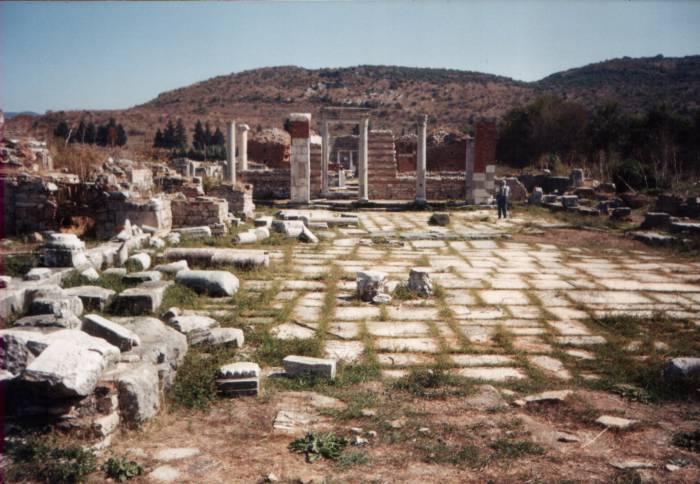
A view down the length of the Church of Mary toward its apse.
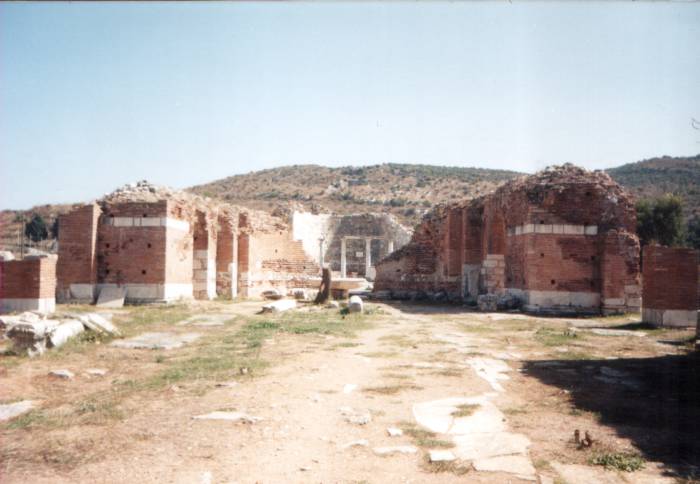
The nave and apse of the church.
The First Council of Ephesus was the third ecumenical council of the early church. Nestorius, the Patriarch of Constantinople, had come into conflict with Cyril, the Patriarch of Alexandria, in an argument over christology, a debate over the precise nature of Christ. There certainly was a political rivalry between Constantinople and Alexandria, but this was an intellectual disagreement.
Nestorius emphasized the disunity between Christ's human and divine natures, a view that then and ever since has been called Nestorianism. It was the dogmatic tradition of Antioch that no union between the human and the divine was possible. Cyril's Alexandrian view said that this was wrong, that it detached Christ's divinity and humanity into two persons existing in one body and thereby denied the reality of the Incarnation by denying that one person was both human and divine, and so Nestorius must recant or be excommunicated. Nestorius asked the Byzantine Emperor Theodosius II to call a council in which he hoped that he and his view would be vindicated.
The Emperors around that time were taking religious actions in their rule. His father, Theodosius I, had shut down the Temple of Apollo at Delphi and the related prophesying by its Oracle. Theodosius II decreed four years after this council, in 435, that all pagan temples in the Empire must be destroyed. The Temple of Olympian Zeus at Olympia was destroyed and the Parthenon in Athens was shut down. The statue of Zeus at Olympia, one of the Seven Wonders of the Ancient World, was destroyed. One story is that it had already been taken to Rome at the order of Caligula, who decreed that the greatest statues from across the Empire should be brought to Rome and have their heads replaced with representations of Caligula. Maybe the statue was instead destroyed when Theodosius had the temple burnt to the ground in 435. Or, maybe it was disassembled and transported to Constantinople only to be accidentally destroyed there in a fire in 475.
As for the similarly gigantic and opulent statue of Athena from the Parthenon, it was taken to Constantinople and survived there until 1204 when the nominally Christian armies of the Fourth Crusade sacked Constantinople and destroyed the statue along with most of the wealthy city.
Some 250 bishops were called to gather in Ephesus, a city with a history of strong support for Cyril's side of the argument. Nestorius' emphasis on the dual nature of Christ attempted to find a middle ground between two views. The first, favored in Ephesus, was that Mary had given birth to God in the form of a man, making her the Θεοτόκος or Theotokos, the God-Bearer. The opposing view was that because God is an eternal being, he cannot be born. Nestorius suggested calling her the Χριστοτόκος or Christotokos, the Christ-Bearer or Messiah-Bearer. Neither side liked that suggestion.
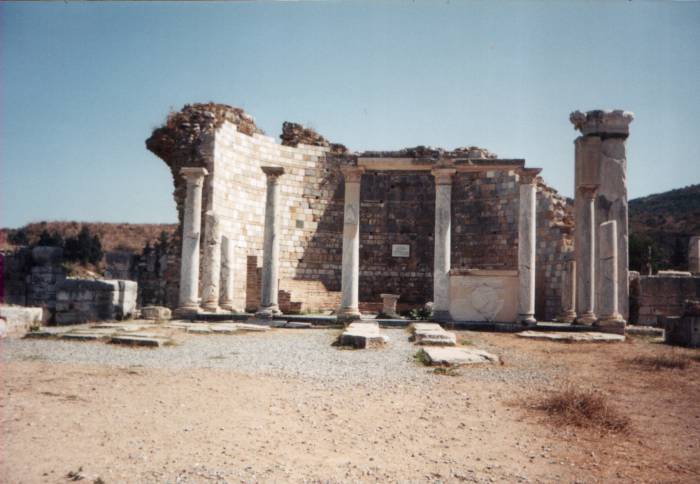
A sign in the apse states that Pope Paul VI visited here in 1967.
Communication and transportation in the early to mid 5th century being what they were, it took a number of weeks for the bishops to arrive despite this being a high priority meeting decreed by the Emperor. This provided plenty of time for the early arrivals to squabble among themselves.
John of Antioch and the other 42 members of his Syrian party, all of whom would support Nestorius, had not arrived when Cyril formally opened the council meeting. They quickly ratified the earlier conclusion that Nestorian was a heretic.
Arianism had been officially decreed a heresy at the Ecumenical First Council of Nicaea in 325. It's another renegade christological view in which the Son of God did not always exist but was created by, and therefore is from, God the Father. Apollinarianism said that Jesus had a human body but a divine mind. Eunomianism was an extreme form of Arianism espoused by Eunomius, who was banished to his birthplace in Cappadocia where he caused grief for Basil of Caesarea.
John of Antioch and his party finally arrived five days later, to be upset that they had made such a long and difficult trip only to find that the council had not waited for them to arrive. They quickly organized their own council, which to what must have been no one's surprise found Cyril guilty of espousing three heresies simultaneously: the Arian, Apollinarian and Eunomian ones.
Things settled down somewhat as the overall council went through six more sessions over the next month. They ended up passing eight official canons. Canons 1-5 condemned Nestorius and Caelestius and their followers as heretics and said that Θεοτόκος or Theotokos, "God-Bearer", was Mary's proper title. Canon 6 condemned anyone who disagreed with the council's decrees. Canon 7 reaffirmed the Nicaean Creed as defined at the First Council of Nicaea in 325, and condemned a more recent modification to it. Canon 8 condemned the interference by John the Bishop of Antioch in the affairs of the church in Cyprus.
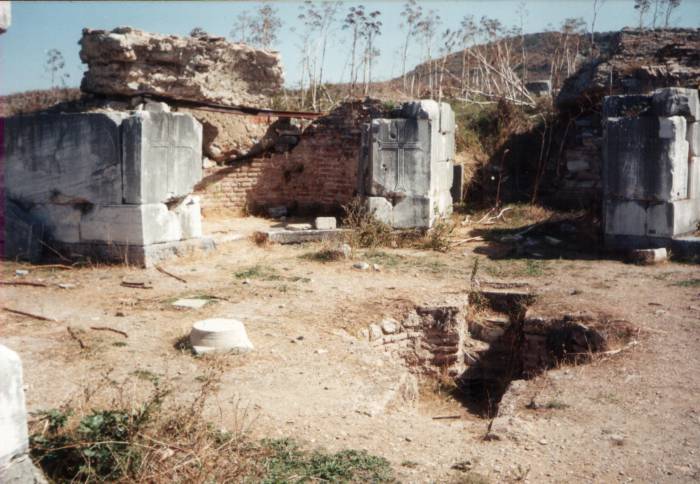
A large baptismal pool is in a side chapel.
The bishops of Cyril's council outnumbered those of John of Antioch's mini-council by almost four to one. All the same, Emperor Theodosius II had been a staunch supporter of Nestorius, the Patriarch of his capital city of Constantinople. So, for a while he officially ratified the conclusions and condemnations of everyone. But after a while the Emperor was convinced to accept the anti-Nestorius conclusions of the largest council.
Nestorius had seen this coming and had requested and received permission to retire to his former monastery. He never backed down, maintaining that he had been the orthodox one all along.
The condemnation of Nestorius and the official anathematization of his teachings led to a major split, naturally enough called the Nestorian Schism. The churches supporting Nestorius, especially those in Persia where they were persecuted by a Zoroastrian majority which accused them of Roman leanings, split off from the rest of Christianity to become what was eventually called Nestorian Christianity. Today this includes the Assyrian Church of the East, the Chaldean Syrian Church, the Ancient Church of the East, and the Chaldean Catholic Church.
Practical matters
Ephesus is just a couple of kilometers from Selçuk. You could take a dolmuş from the town center, although your guesthouse could probably give you a lift.
Walk from Selçukto Ephesus
However, it is a pleasant and very interesting walk from Selçuk to Ephesus You pass the Temple of Artemis, a rock-cut shrine to the Mother Goddess, and the Cave of the Seven Sleepers. Click here for a description of that walk and detailed directions.
Ephesus is open 0800-1700 daily.
To SamosFerries run daily between Kusadaşı and Samos during the high season.
Check with your guesthouse in Selçuk for details, and what the current visa requirements are. You will probably have to buy your ticket a day in advance.
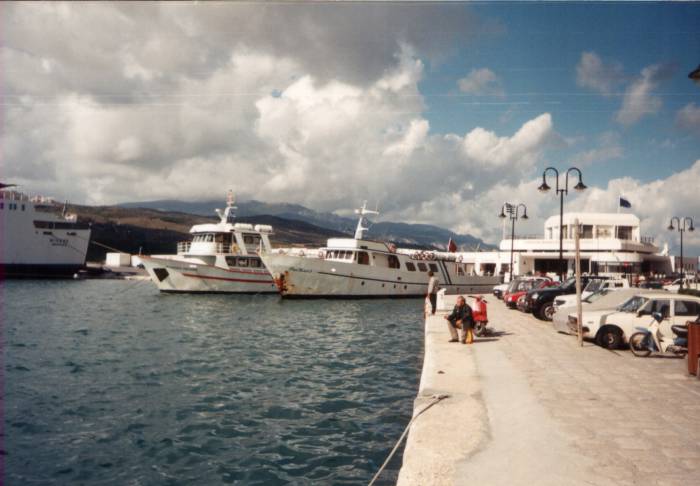
The small ferry from Kusadaşı has arrived at Samos.
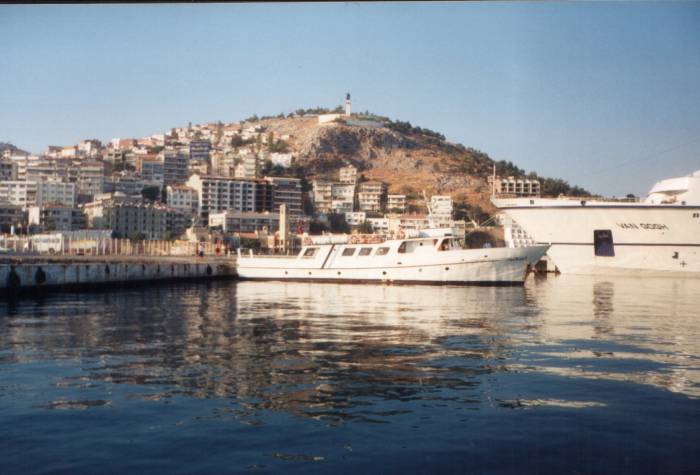
This small ferry is preparing to leave Kusadaşı and cross to Samos.