
Learning Greek

A Greek Study Guide
I have been
to Greece a number of times,
and I have tried to pick up some bits and scraps of
the language.
Duolingo
I have been very happy with the Duolingo
smart phone app.
Greek
By Radio
I had used the recordings of the "Greek By Radio" program
from the Cyprus Broadcast Company.
It's 105 audio files, each about 15 minutes long,
plus some corresponding web pages with the complete text,
vocabulary tables, and so on.
Eleven years later, I was going back to Greece, and
I found the Duolingo app to be
far superior.
Follow the link to my old notes on the
Greek by Radio
programs if you want, but here are my study notes for
the much more useful Duolingo smart phone app.
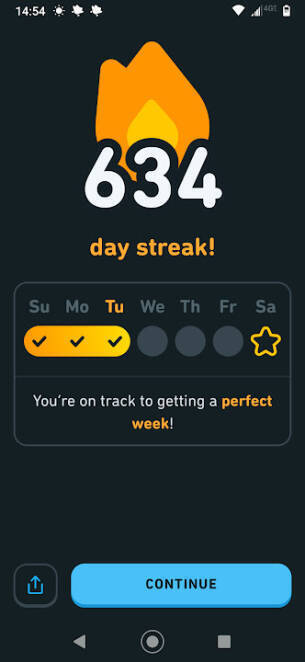
I did the Duolingo Modern Greek course from August 2021 through April 2023, and managed to do a module almost every single day. You can miss a few and still maintain a continuous streak. So yes, I started it when it was the "Tree" and then it switched to the "Learning Path" mid-way through.
I had wondered what would happen when I reached the end. At the time I did the course, that meant through Unit 61. As you see in the second picture below, there's no scroll button, no way to scroll down beyond the end of Unit 61.
When you get to the very end, you can grab screenshots but that seems to be it.



Duolingo's goal is to get you to the A2–B1 level as per CEFR. That seems about right, based on my understanding of the CEFR table. The U.S. State Department's Foreign Service Institute says that Greek is a "hard language" requiring about 44 weeks or 1,100 class hours, similar, they say, to many non-Indo-European langauges such as Amharic, Azerbaijani, Estonian, Finnish, Georgian, Hebrew, Hungarian, Kazakh, Khmer, Kyrgyz, Lao, Mongolian, Somali, Thai, Tibetan, Turkish, Turkmen, Uzbek, and Vietnamese.
I know just enough about Turkish to know that it (and thus other Turkic languages in the list such as Azerbaijani, Kazakh, Kyrgyz, Mongolian, Turkmen, and Uzbek) would be, at least for me, extremely more difficult. I took some Russian classes in college, and so the Greek alphabet wasn't a big deal at all for me. Greek word order, at least in the sentences in the Duolingo content, is often word-for-word identical to English. It's nothing like the Yoda-like SOV order of Turkish where you the verb at the end must put.
I largely agree with this guy's review, although while it says it's from July 2022 it seems to be discussing a significantly earlier version. For example, I started in August 2021 and the Greek course had hints and tips in the mobile app.
I very much enjoyed the list of the weirdest Duolingo sentences. Early in the Greek course, when the combination of adjectives and possessives was a new thing, there was much discussion of the underwear of the orange elephant, which didn't make that list.
As for some type of final exam or a certificate of completion to download, there isn't anything. I've read of an exam you can pay something like $ 55–60 to take, but only for English, and this is probably some TOEFL or Test of English as a Foreign Language certification run by someone other than Duolingo.
These pages have basic grammar tables. Not exhaustive, but the "just enough" versions that I needed to create while going through the Duolingo lessons.
Some of these pages became my personal study guide. Maybe you will find it useful. I know that I do.
Hunter S. Thompson on Learning by WritingI'm convinced that Hunter S. Thompson was right. An effective way to learn something is to figure out how to explain it to someone else. What really matters? What is the minimal explanation? What must you know? I don't claim to know much about the Greek language, but the best way I know to learn anything by myself is to set out to explain it.
Alphabet
It is not too difficult to deal with the language. Really. You will have an advantage if you happen to know any Russian or other East Slavic languages, as Saints Methodius and Cyril devised the Cyrillic alphabet using Greek as much as possible in the cases of similar sounds. Apparently Methodius did most of the work but Cyril got the credit, hence the alphabet's name "Cyrillic" and not "Methodical".
Here's the alphabet — the capital and lower case Greek, the letter's name, and the very approximate English (and NATO and Old English and Scottish and French) equivalent. If you just see boxes or gibberish, use a better browser that understands Unicode.
| Greek | Name | English |
| Α α | Alpha | A as in "father" |
| Β β | Beta | V as in "Victor" |
| Γ γ | Gamma | G as in "goat" |
| Δ δ | Delta | Ð as in "there" |
| Ε ε | Epsilon | E as in "get" |
| Ζ ζ | Zeta | Z as in "Zulu" |
| Η η | Eta | I as in "feet" |
| Θ θ | Theta | Þ as in "thick" |
| Ι ι | Iota | I as in "feet" |
| Κ κ | Kappa | K as in "Kilo" |
| Λ λ | Lambda | L as in "Lima" |
| Μ μ | Mu | M as in "Mike" |
| Greek | Name | English |
| Ν ν | Nu | N as in "November" |
| Ξ ξ | Xi | X as in "ox" |
| Ο ο | Omicron | O as in "hOt" |
| Π π | Pi | P as in "Papa" |
| Ρ ρ | Rho | R as in "Romeo" |
| Σ ς, σ | Sigma | S as in "Sierra" |
| Τ τ | Tau | T as in "Tango" |
| Υ υ | Upsilon | I as in "feet" |
| Φ φ | Phi | F as in "Foxtrot" |
| Χ χ | Chi | CH as in "loch" |
| Ψ ψ | Psi | PS as in "lapse" |
| Ω ω | Omega | O as in "note" |
| Greek | English |
| αι | ai as in "aisle" |
| αυ | av as in "mauve" before
vowels or voiced consonants af as in "off" otherwise |
| ει | ee as in "feet" |
| ευ | ev as in "ever" before
vowels or voiced consonants ef as in "left" otherwise |
| ηι | ee as in "feet" |
| ηυ | iv as in "shiver" before
vowels or voiced consonants if as in "if" otherwise |
| οι | ee as in "feet" |
| ου | oo as in "food" |
| υι | ee as in "feet" |
Because of a process called ἰωτακισμός or iotacism, many vowels and diphthongs in Ancient Greek converged so that in Modern Greek η, υ, ει, ηι, οι, and υι are all pronounced the same as ι.
References
Techniques for learning thingsI'm pretty sure you will want a dictionary. Among other uses, you can make lists of categories of words. Don't try to memorize long lists of things, break them into manageable groups of five to seven.
Colors, days of the week, time terms (now, later, today, tomorrow, etc) directions (near, far, here, there, to the left, to the right, etc), and so on. Whatever makes sense for you.
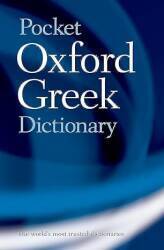
A basic and grammar reference also makes sense. Dover sells a cheap but odd and outdated one. It's from from 1950, with outdated phonetic marking from the era of katharevousa, a failed project to make modern Greeks speak a hybrid language resembling Classical or Ancient Greece. It shows the polytonic orthography, using five diacritics to indicate three types of pitch accent plus "rough" and "smooth" breathing for initial vowels. Amazon reviews from actual Greeks say "This isn't modern Greek" and "Not even my grandma uses this language anymore!"
Amazon 041559202X
Amazon 041559202X
If you search for greek grammar at Amazon,
much of what you find will be either Classical Greek,
the Attic Greek of 500–300 BCE,
or New Testament Greek, the Koine Greek of
the common people of 300 BCE to 350 CE.
The Yale textbook
A Manual of Modern Greek
seems to have the right aim, but its reviews indicate
that it resembles a 1970s military manual,
with its pages filled with constant-width font.
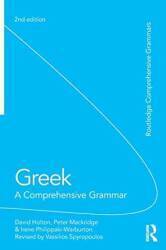
Routledge has the right idea. The Routledge Essential Grammar and Comprehensive Grammar are the best references for actual modern Greek.
Katharevousa (or καθαρεύουσα)
The Colonel's Coup in 1967 was accompanied by the typical authoritarian demand to return things to an idealized superior "before time". Part of this was the demand for using a more formal language, called καθαρεύουσα or katharevousa. Should the official language of the Greek nation be the language the people spoke, or should it be a cultivated imitation of ancient Greek?
A language purity movement had begun in the late nineteenth century, aiming to wipe out the linguistic influence of the Byzantine Empire and the following Ottoman Empire. Language fanatics wanted to have everyone in Greece speak the prestige Attic dialect of literary classical Greek of 500–300 BCE.
The Koine Greek that the people spoke in about 300 BCE to 350 CE was the common people's language. The New Testament was written in Koine, it was the official language of the Byzantine Empire until it fell in 1453, and it survives as the liturgical language of the Greek Orthodox church. But that was too modern and casual for the katharevousa advocates.
Katharevousa was archaic, with syntactical, morphological, phonological, and lexical features of Ancient Greek. It was an artificial hybrid of a language that had never been spoken by anyone. This meant that it was only partly intelligible to a Greek person without a higher education.
By the late 1800s, it had gotten to where an educated Greek citizen could usually figure out what written Katharevousa meant, with substantial effort, but they couldn't write it. Literacy was suffering. The attempt to impose it as an official language cut people off from government, public life, and literature. The Wikipedia page on the Greek language question says, in a note:
The names of everyday objects were particularly resistant to "purification". Necktie remained γραβάτα (Italian cravatta) and coffee stayed καφές (Turkish kahve). The "purified" alternatives λαιμοδέτης "neck-tie" and the much-ridiculed νηφοκοκκόζυμον "sober-berry-brew" never did win popular support.
Then in April 1967 a group of right-wing military officers seized power in a coup d'état. The regime of "The Colonels" as it was known imposed a strongly authoritarian government. Part of this was a link between Katharevousa and the government itself. Demotic or Δημοτική, the common Greek language of the people, was banned from education. Demotic Greek was criticized as a jargon or slang that didn't even have a grammar, and the language was accused of being connected to communism and treason.
When The Colonels' regime collapsed in July 1974, that was the end of Katharevousa. Article 2 of Law 309 — still written in Katharevousa as all laws were then — decreed that Modern Greek, the Demotic spoken by the people of Greece, should be the only language used in education at all levels. Standard Modern Greek became the official language of administration in 1977, and over the next ten years the whole legal system was converted and rewritten. In 1982 a presidential decree imposed the monotonic written accent system on all education. It uses only the tonos or mark for stress, and the diaresis to indicate separated vowel sounds (as the same mark does in English and French, as in naïve, coöperate, and Noël). The pitch accents and the marks for "rough" and "smooth" breathing for vowels disappeared, as they only indicated how words had been pronounced over two millenia earlier.