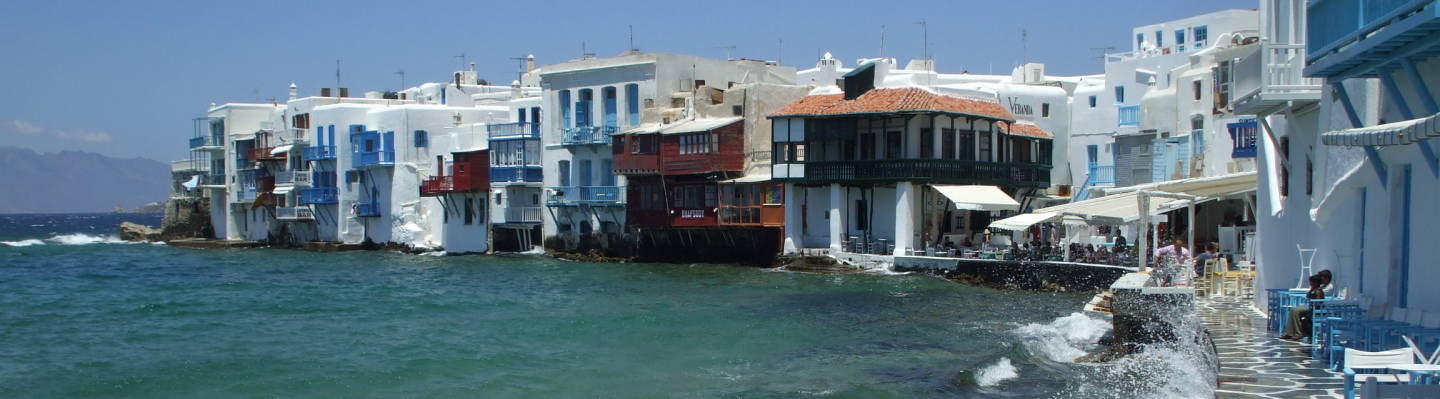
The Greek Island of Mykonos
Mykonos / Μύκονος
Mykonos is one of the best Greek islands to visit. It and Santorini are the two islands most visited by foreign travelers and cruise ships, for reasons that are obvious when you arrive on either one. Mykonos is marketed to Europe as the home of the best nightlife on the European continent with good reason. The top music producers and DJs come to its clubs and beach bars in the high season, July and August.
Mykonos has been a popular tourism destination for ages. The nearby island of Delos was a sacred island. It was famous as the birthplace of the twin deities Apollo and Artemis by the time that Homer was composing the Odyssey. Delos was a major religious center from 900 BCE through 100 CE. At times Delos was heavily populated, and at other times it was a religious sanctuary with no non-priestly permanent residents. Either way, Mykonos provided supplies and was a stage along the way to visit it.
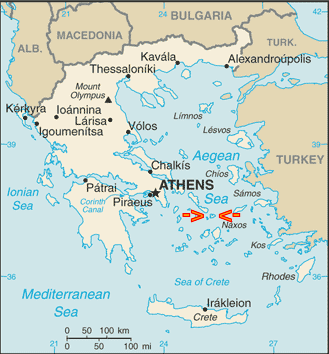
Map of the Greece and the Aegean Sea. Μύκονος (or Mykonos) is between the orange pointers.
With the rise of the concept of the Grand Tour among the educated from the mid to late 1600s through the 1840s, and even more so with the intellectual fashion of Philhellenism through the 1800s, Mykonos started to see visitors from western Europe, largely Britain. They came to see Delos, which is the premier historical and mythological site in the Greek islands. It was nearly uninhabited, but Mykonos was just a few kilometers away.
All these eccentric Britons started arriving at Mykonos. Some insisted on speaking the Koine Greek in which the New Testament was written. Others spoke Homeric Greek. Imagine a modern visitor to London who insists on speaking the Anglo-Saxon of Beowulf. This was at least twice as anachronistic.
They would arrive by boat, having bought their way on a fishing or cargo vessel, and they would ask the harbor master for a place to stay. There was nothing like a hotel at the time, but various elderly widows would have spare rooms that they might rent. This was the start of the business of domatia, or rooms for rent, in the Greek islands.
Check ferry schedules and buy tickets:
Logistics
These days it is much easier to get there and to find a place to stay, at least if you don't show up during high season.
Mykonos is just a short hop by ferry or air from Athens. Use this search engine to explore ferry schedules, and you can even buy your tickets online.
I prefer the classic Greek inter-island ferries with open decks, where you can relax and watch the sea and islands slide by.
Many ferries depart Athens' port of Piraeus around 0700 to 0800. Piraeus is an enormous port and it gets very busy with all the early morning departures. You would have to arrive there well before your ferry's departure time. A late morning to mid-day departure sounds much better to me!
Mykonos is in the northern arc of the Κυκλάδες, the Cyclades, the islands around the sacred island of Delos. The Cyclades islands are mostly the peaks of submerged mountainous terrain, with the exception of the two volcanic islands of Milos and Thera (Santorini).
The below map shows the island's location in the northern Cyclades. It's just three hours by fast catamaran and four and a half to six hours by traditional ferry from Piraeus, and only 45 minutes by air from Athens. This is a portion of an aeronautical chart showing Mykonos and the nearby islands of Tinos, Syros, and Delos.
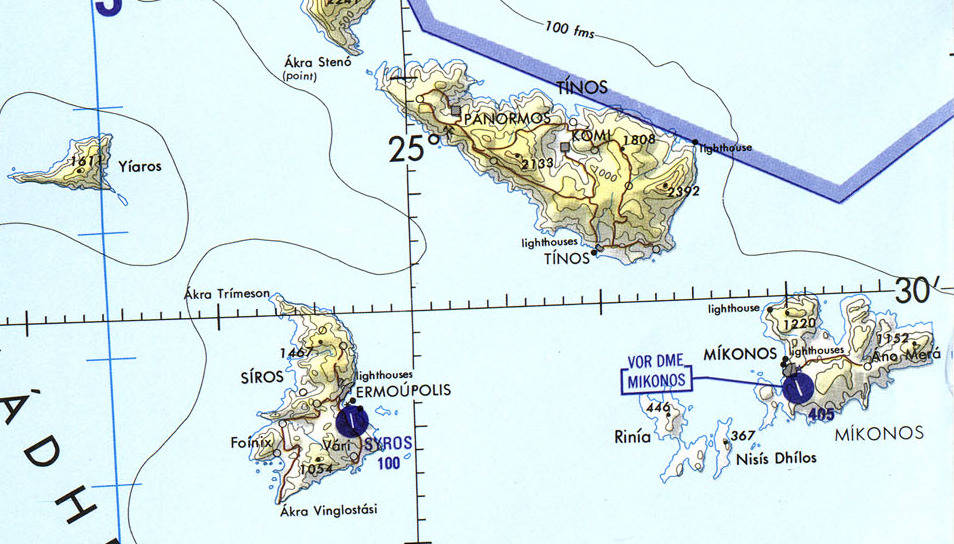
Aeronautical chart of the Aegean Sea. Original full resolution map available from the University of Texas' Perry-Castañeda Map Collection.
There have been various systems for transliterating Greek words into the Latin alphabet. The real names of the islands are Σύρος, Τήνος, Δήλος, and Μύκονος. The map above used Síros, Tínos, Dhílos, and Míkonos. Today, English speakers usually spell them as Syros, Tinos, Delos, and Mykonos.
If you arrive by ferry, the main town or Hora is also the port. Hora or Χορα is the general name for the primary town of an island. On many of the Greek islands, the main town is known simply as Hora. With Mykonos being a popular tourist destination, its Hora has also come to be known by the island's name.
| Tower: | 119.875, 122.1, 257.8 MHz |
| Approach: | 118.75, 122.1 MHz |
| NDB: | MKO 401 kHz |
The Mykonos airport (IATA: JMK, ICAO: LGMK) was built in 1971, with a 1900 meter runway. Aegean Airlines, Astra Airlines, Olympic Air, and Sky Express operate year-round. During the high season, several airlines fly direct from Austria, Belgium, Germany, Israel, Italy, the Netherlands, Turkey, and the U.K.
It's about 4 kilometers from the airport to town. There is no public bus service, taxis cost 5–10€.
One way or another, you'll get to the Hora. Cafes and an array of travel-related businesses line the waterfront. A number of places sell ferry tickets, both for a one day excursion to the sacred island of Delos and for inter-island connections.
Mykonos Hora Waterfront
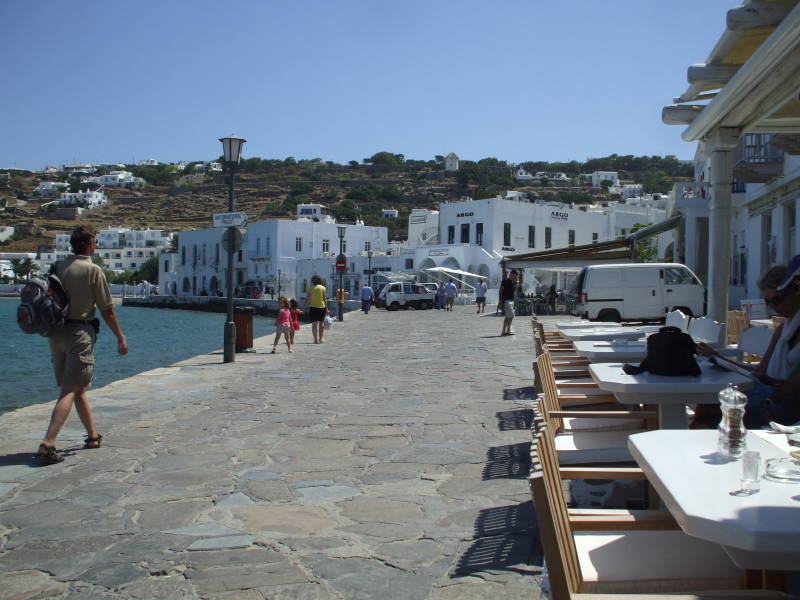
Tables at cafes along the harbor on Mykonos.
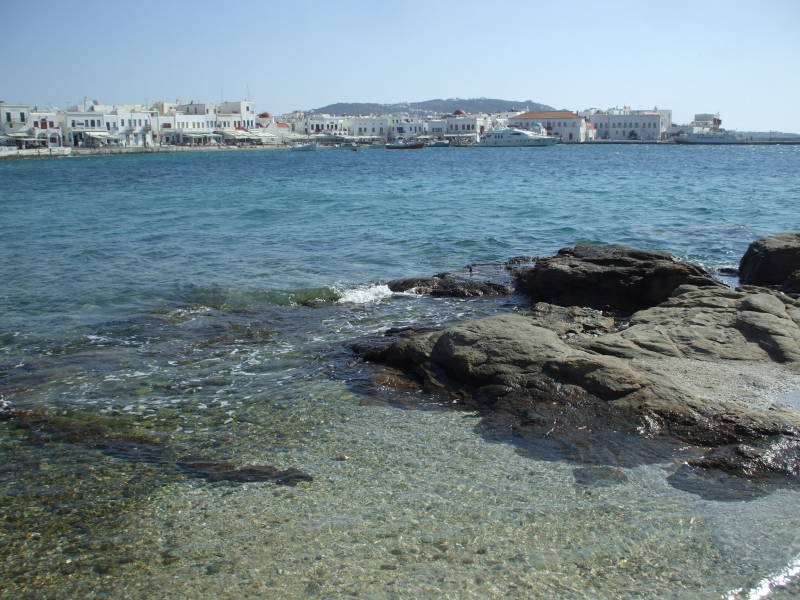
Looking across the harbor to waterfront cafes.
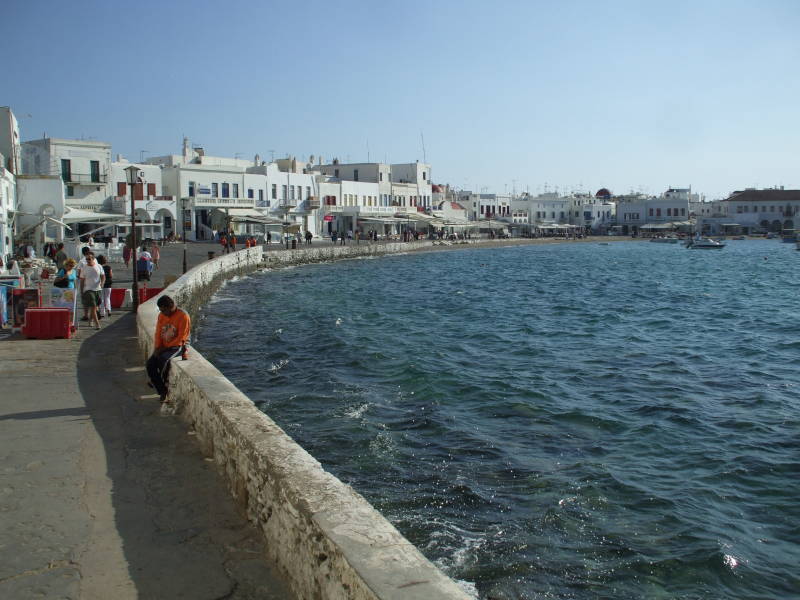
Looking across the harbor to waterfront cafes.
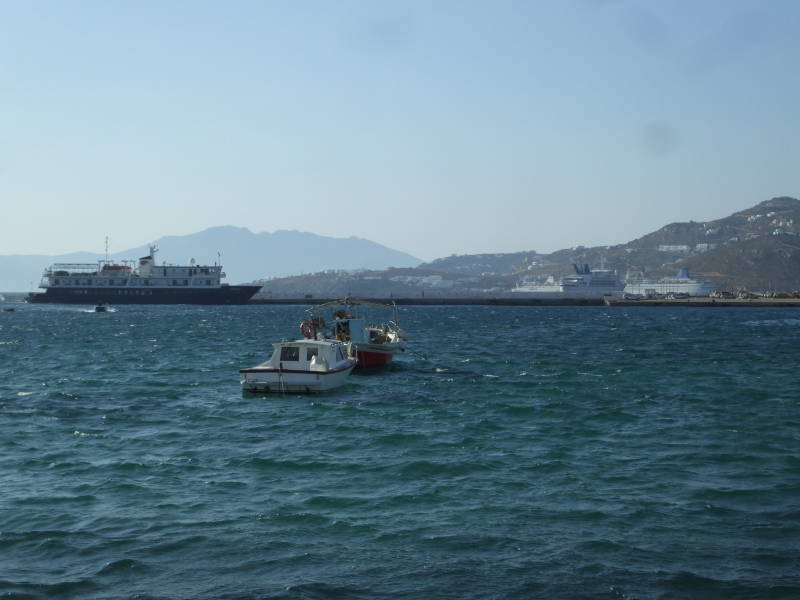
Looking across the old harbor to the ferry pier, and in the distance, the cruise ship port.
The gigantic cruise ships pull in to their own port, across the bay from the Hora and well out of town. That's very good, as it keeps them from overwhelming the very nice atmosphere of the main town.
These vessels are of a far more appropriate size to provide a nice atmosphere!
There is still a lot of small-scale fishing out of Mykonos. The covered object just above the waterline beyond this fishing boat is a large marble-topped table used for the daily fish market.
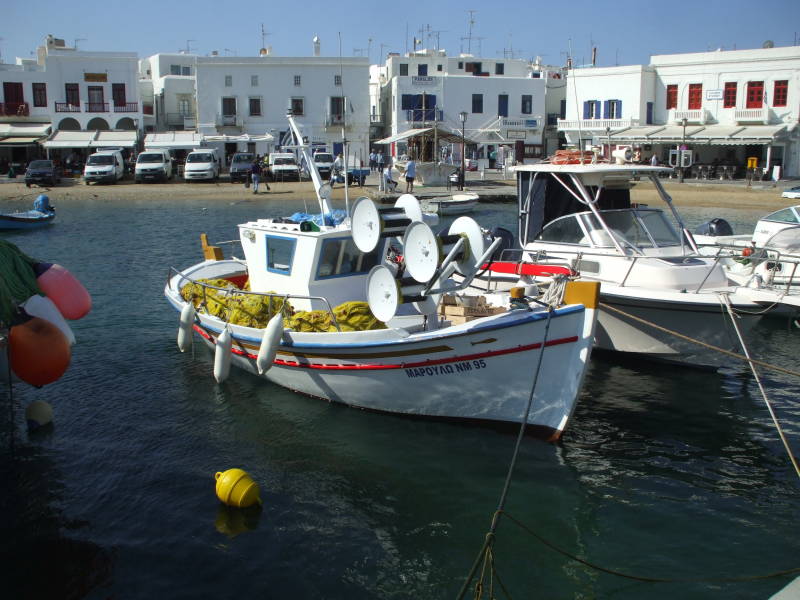
Fishing boats in the harbor on Mykonos.
The cafes make their daily purchases here.
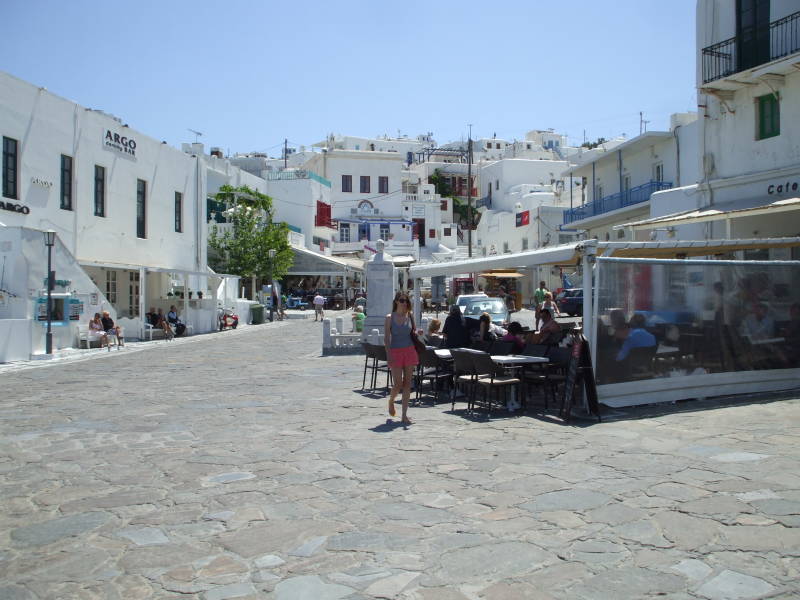
The fountain at the main square of Plateia Manto Mavrogenous in Hora on Mykonos.
Exploring the Hora
Plateia Manto Mavrogenous is the main square, although it's commonly called "Taxi Square". It's toward the north-east corner of the Hora, and is the furthest that a taxi or other full-sized vehicle can venture into the narrow streets, or really passageways, of the old town.
This donkey could carry freight into the center of the Hora, as could small ATVs, but that's about it.
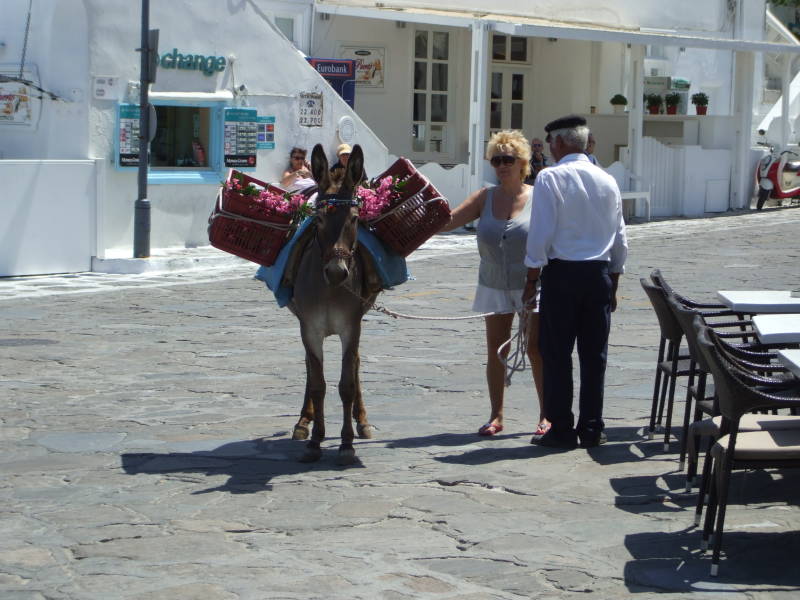
Local freight transport in Hora on Mykonos.
Odos Matogianni leads south from Plateia Manto Mavrogenous. This is where the main street through town opens into the main square. Really, you are looking into the main street where it enters the main square.
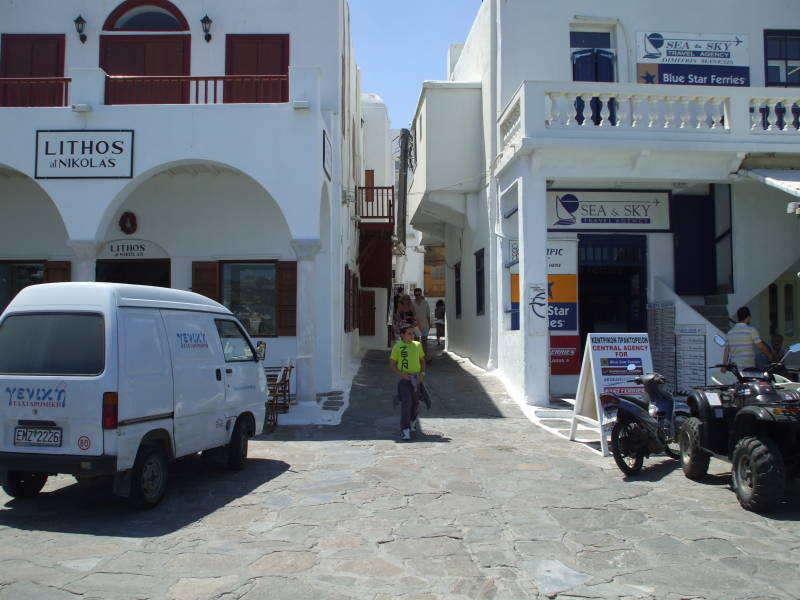
Matogianni is the main street south from Plateia Manto Mavrogenous.
Christian pirates ravaged the Cyclades through the 1600s. This led to the narrow twisting streets of the Hora. They not only block the strong and nearly constant winds, but they also slow down hordes of rampaging pirates.
The prevailing color scheme is white with blue trim. Sometimes light blue, some times dark, and sometimes another color altogether.
Flowering vines, many of them Bougainvillea, climb overhead.
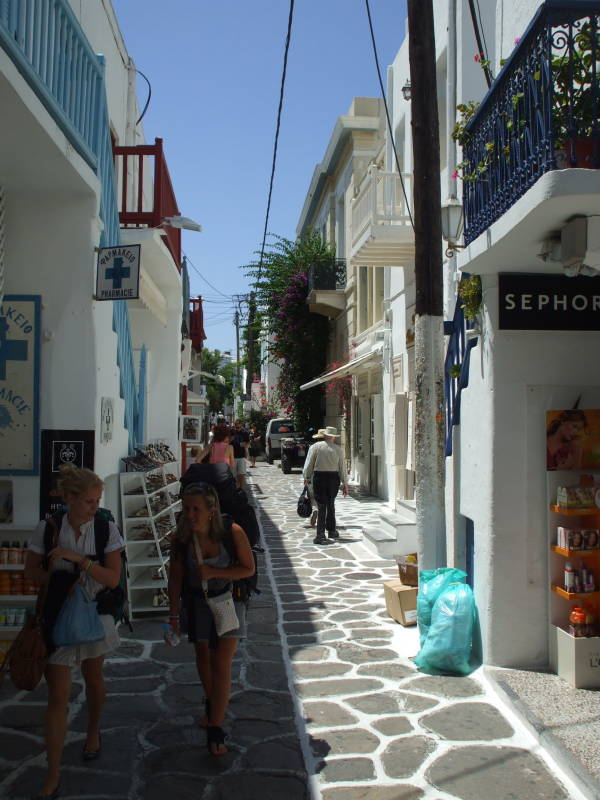
Walking south on Matogianni.
Here we are walking south on Matogianni, the main passageway. Lots of shops, a few banks, bars and restaurants line this street. This couple sits outside a nice little grocery store as the world walks past.
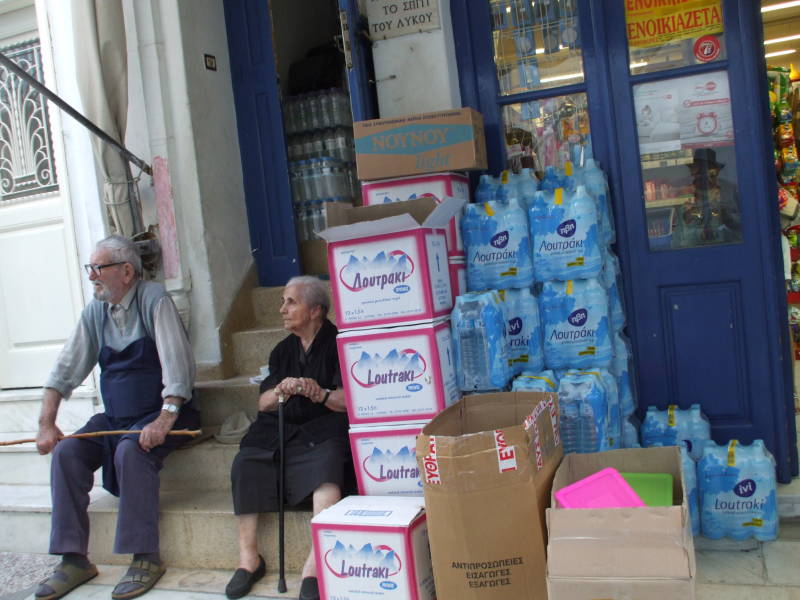
A local couple watches everyone walking along Matogianni.
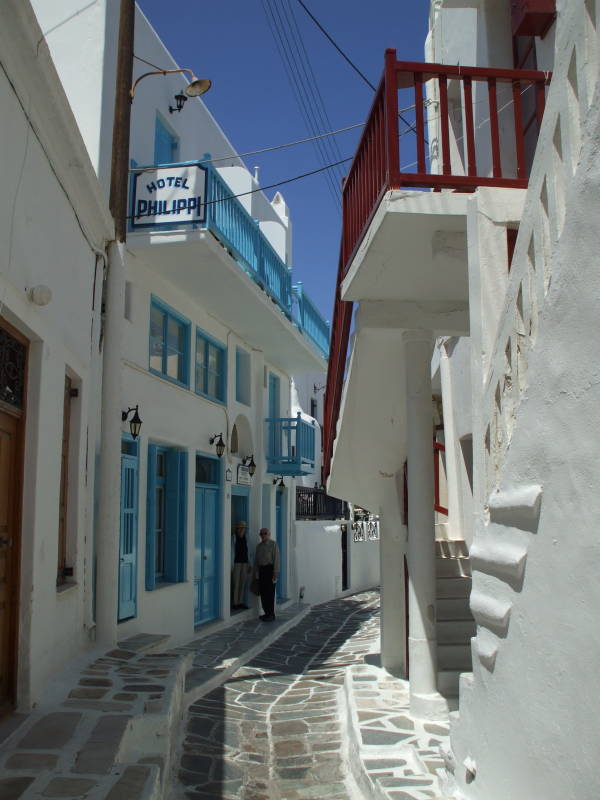
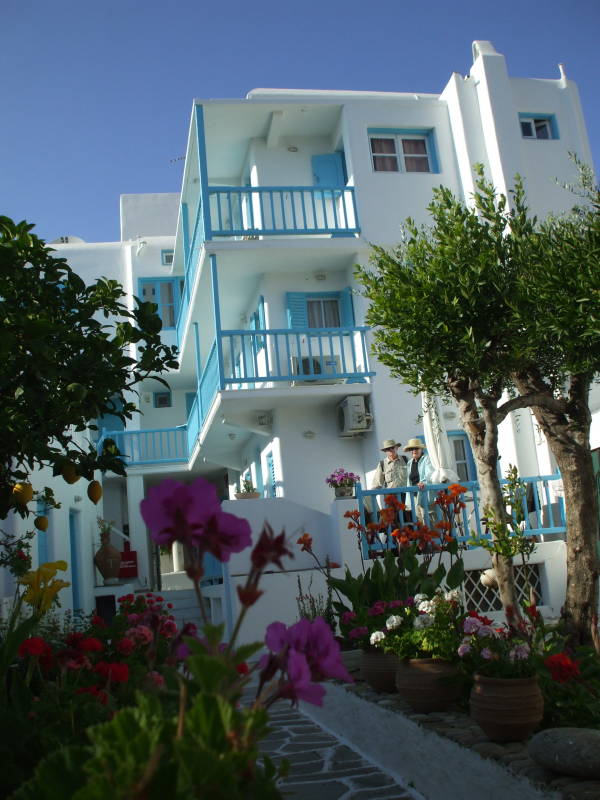
Below is Hotel Philippi, which was a great place to stay. First the entry, then the garden overlooked by the rooms and their balconies. It was at Odos Kalogera 25 or Οδος Καλογερα 25, Hora, Mykonos. That was in 2010. By 2021 it was converted to a high-end jewelry store.
Hedonism and Chapels
As Lonely Planet continues to reorient itself more toward the luxury travel market, great budget places like Hotel Philippi get less attention and even are dropped from their listings. Get an older edition for budget lodging ideas. And for the very top end, Mykonos has luxury villas the guide books don't list.
Lonely Planet has also portrayed Mykonos as Hedonism Island, and at times, even as Super-Gay Island. Well, yes, there is some hedonism to be found there, and a few gay bars and beaches, but it is a Greek island. That means that there are many churches. Hundreds of them.
You don't walk very far at all before passing another small church. Sometimes two small chapels face each other across a narrow passage, or sit side by side.
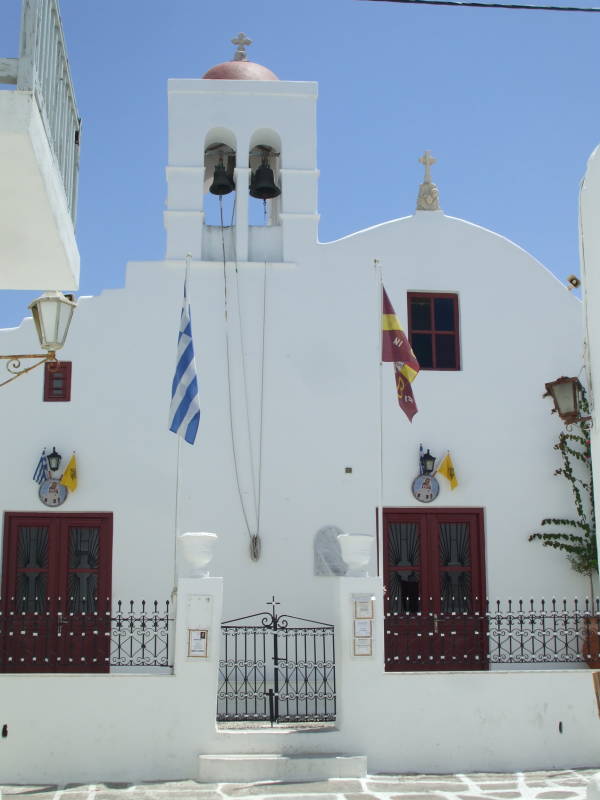
Exterior of a church.
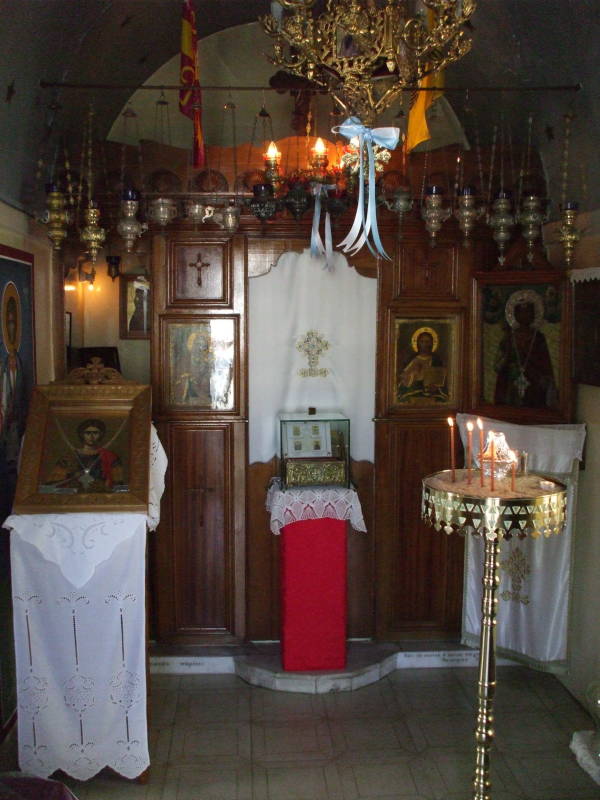
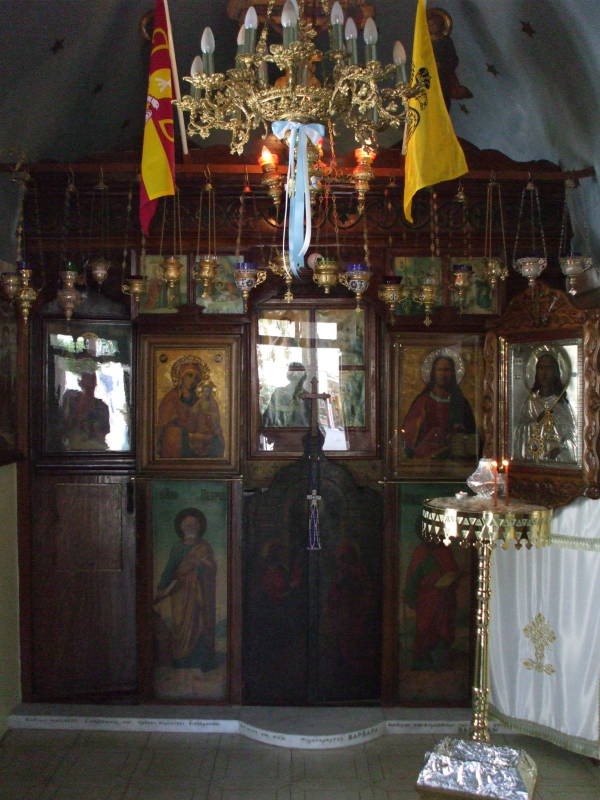
Below are the interiors of two small chapels. The iconostasis of an Orthodox church divides the nave from the altar area.
An iconostasis is built and decorated following a a very specific design. The row of icons about eye level to either side of the central doorway is called the worship row. The icon to the right of the central door shows the saint or the event of the church's dedication. The icon to the left typically shows the Παναγία or Panagia, a specific pose of Mary with the infant Jesus.
If there are icons on the doors, typically they show the Annunciation at the top, then the four gospel writers below that.
Amazon
ASIN: 0913836990
For further details, see the paper "Icons in Theory and Practice" by Margaret E. Kenna, History of Religions, vol 24, no 4 (May 1985), pp 345-368. Also see the book The Meaning of Icons by Leonid Ouspensky and Vladimir Lossky, St Vladimir's Press, 1982.
Above the central door is the place for the Communion of the Apostles.
Then, at least in larger churches, there may be four rows of icons spanning the entire iconostasis above the doors. The first is the Δέησης or Deësis (or prayer or supplication) row, with Christ in Majesty or Χριστός Παντοκράτωρ or Christos Pantocrator at the center. He is flanked by the Virgin Mary and John the Baptist, with archangels Michael and Gabriel flanking them, and other saints spreading to either side.
The second row up would show the great liturgical feasts, twelve or so depending on the size of the iconostasis.
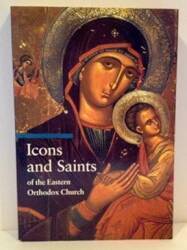
Amazon 0892368454
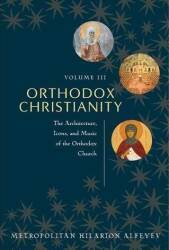
Amazon 0881415030
The third row up would show the Virgin of the Sign (Mary with both hands raised in prayer, with a circle on her breast showing Jesus with his right hand raised in blessing) at the center, with Old Testament prophets extending out on either side.
The top row would show the icon of the Hospitality of Abraham (the three angels who visited Abraham at Mamre, sometimes called the Old Testament Trinity) with the Old Testament patriarchs from Adam to Moses on either side.
Walking Around Mykonos Hora
The buildings are all smooth and white, predominantly with blue trim but also other shades.
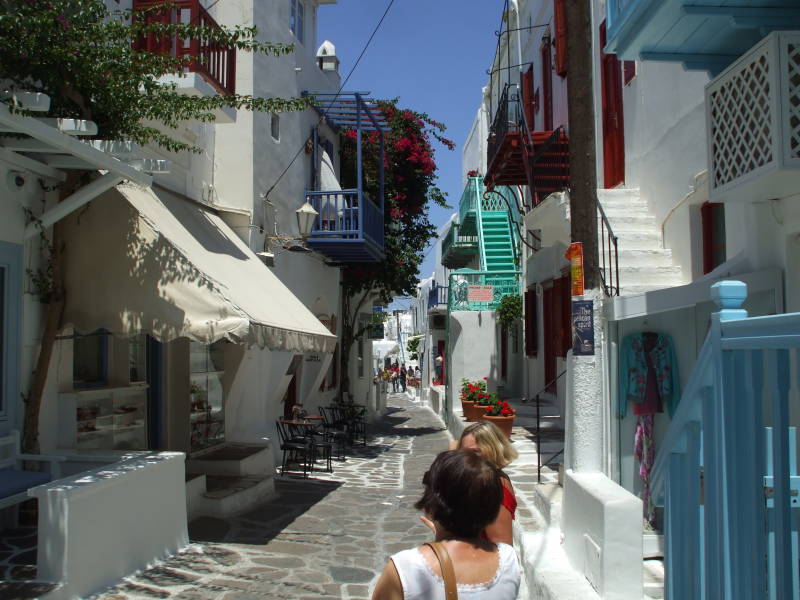
One of the main streets.
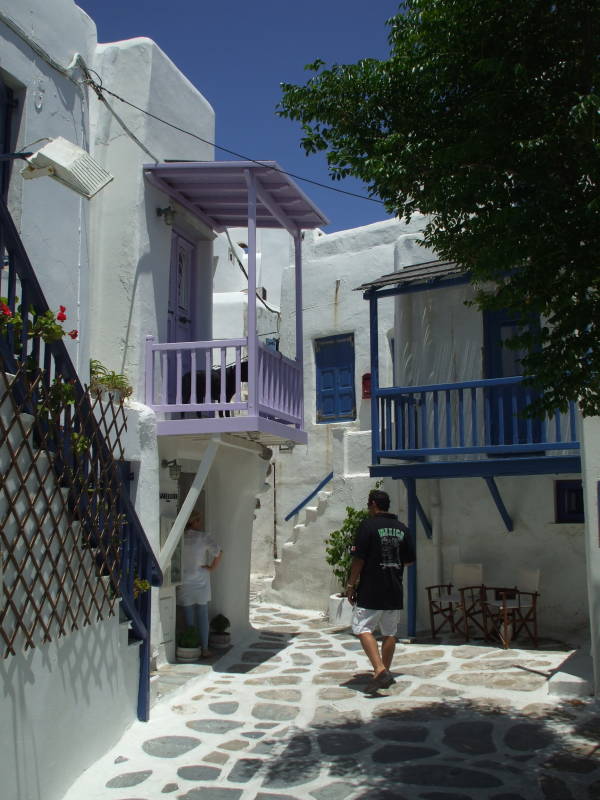
Back streets on Mykonos.
The Cyclades Islands have their own distinctive architecture. This includes their typical windmills.
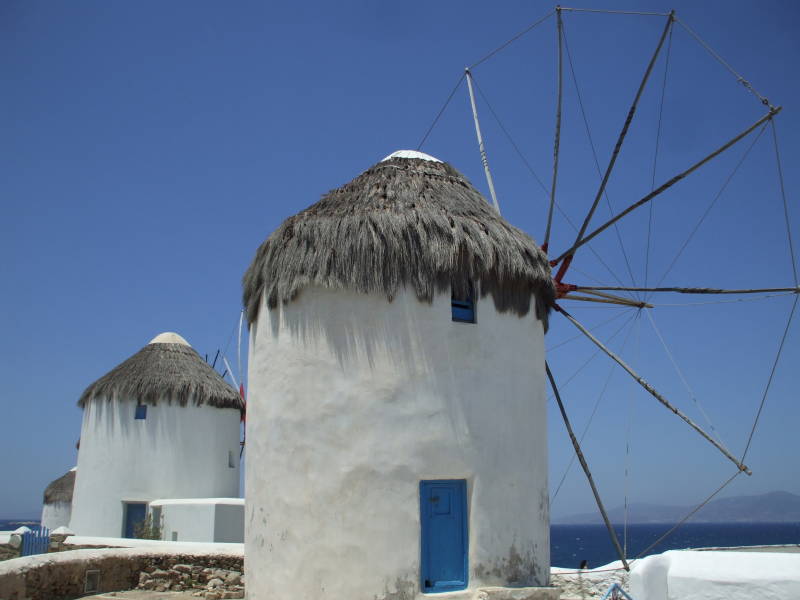
The windmills above Alefkandra, overlooking the small bay and Little Venice.
The popular area of Venetia or "Little Venice" sits just across the small bay, below the row of windmills at Alefkandra.
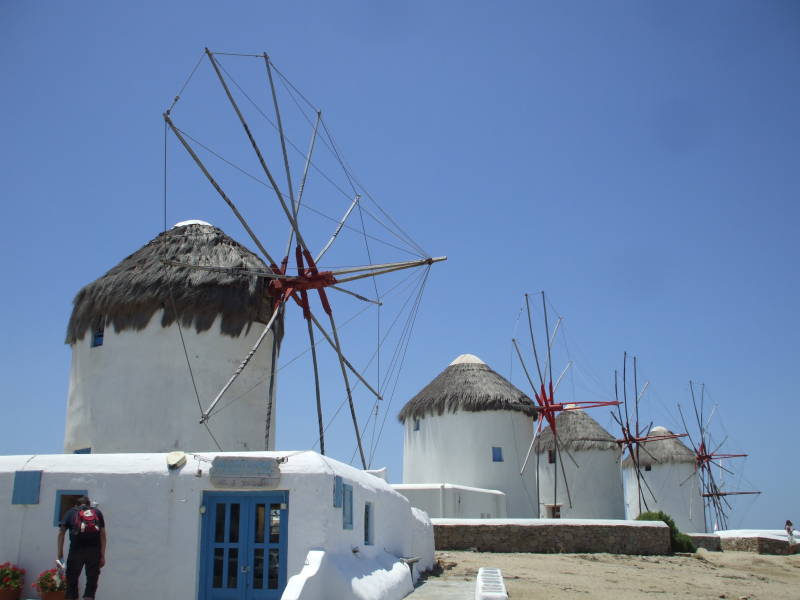
The windmills above Alefkandra, overlooking the small bay and Little Venice.
If you've seen The Bourne Identity, Little Venice appeared at the very beginning and end.
A narrow walkway leads you right along the waterline into Little Venice.
A small pebble beach is immediately below the row of windmills. Beyond that, the buildings are built very close to the water, and beyond that, right up to and overhanging the water.
Amazon
ASIN: B000Q76K1A
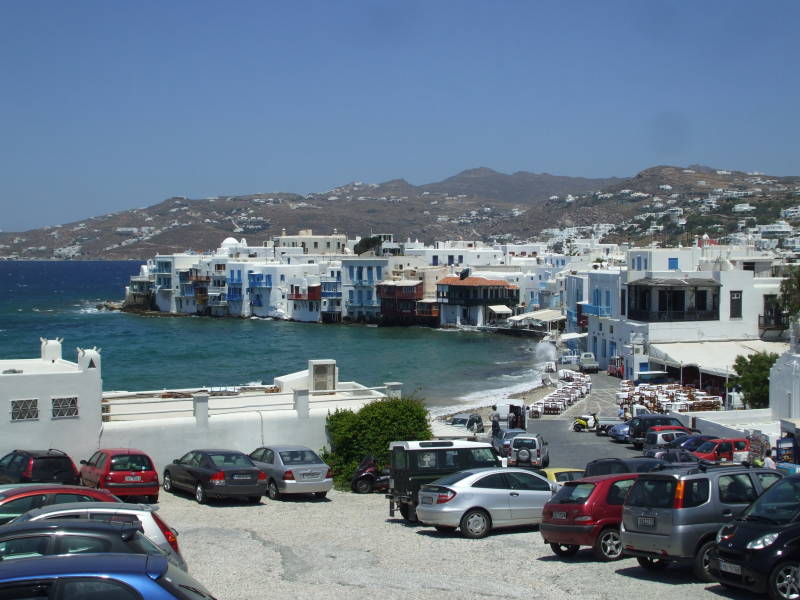
Looking down from the windmills across the small bay toward Little Venice.
Amazon
ASIN: B003H6KRIE
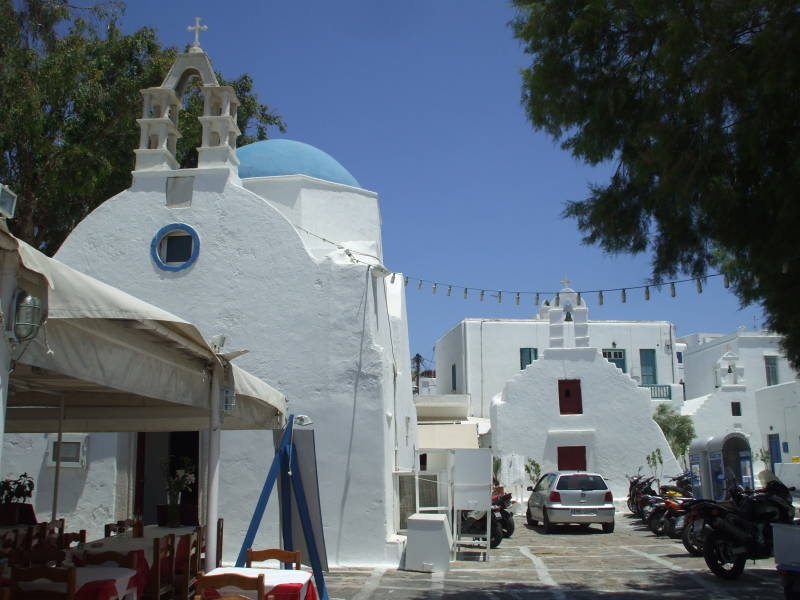
Two churches near Little Venice.
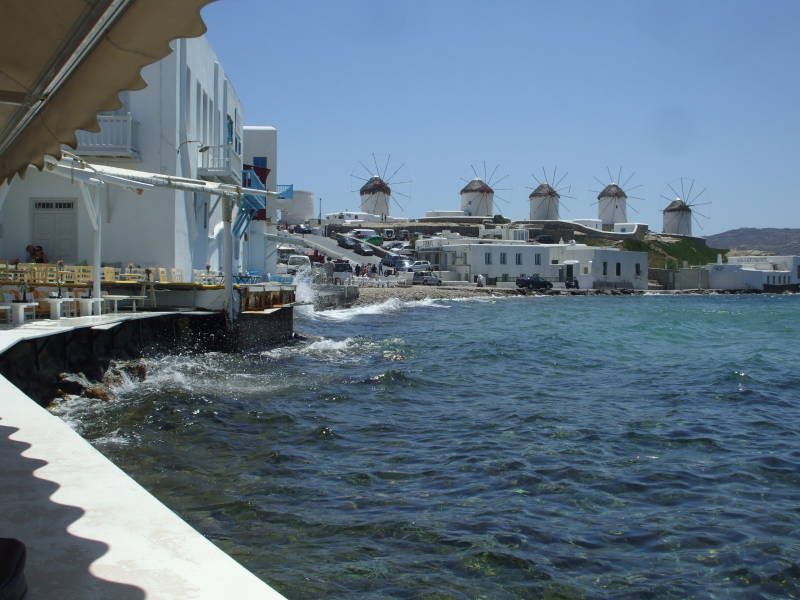
Looking up toward the windmills from Little Venice.
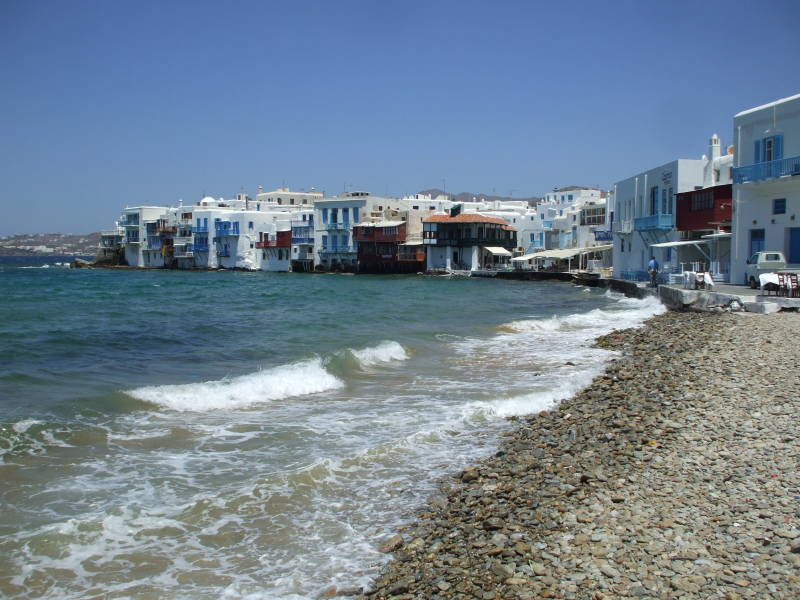
Little Venice, on the west side of Hora, on Mykonos.
Watch your step! The waves splash up onto the narrow walkway.
You can see in the distance that some of the building foundations are in the edge of the water. Some balconies, and even parts of entire buildings, hang out over the water.
The walkway passes through the seating of a few waterfront bars. Seating is wide open early in the day, but it fills in as afternoon comes.
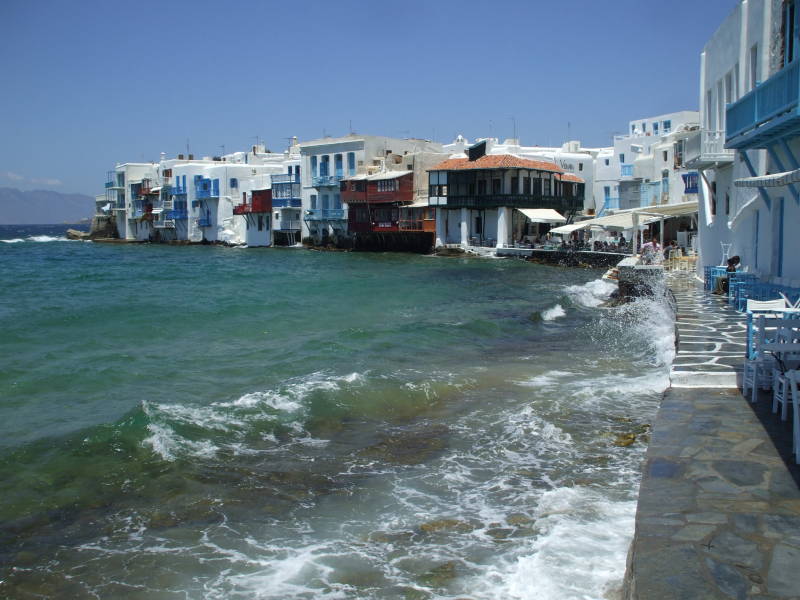
The waves come right up onto the walkway as you approach Little Venice.
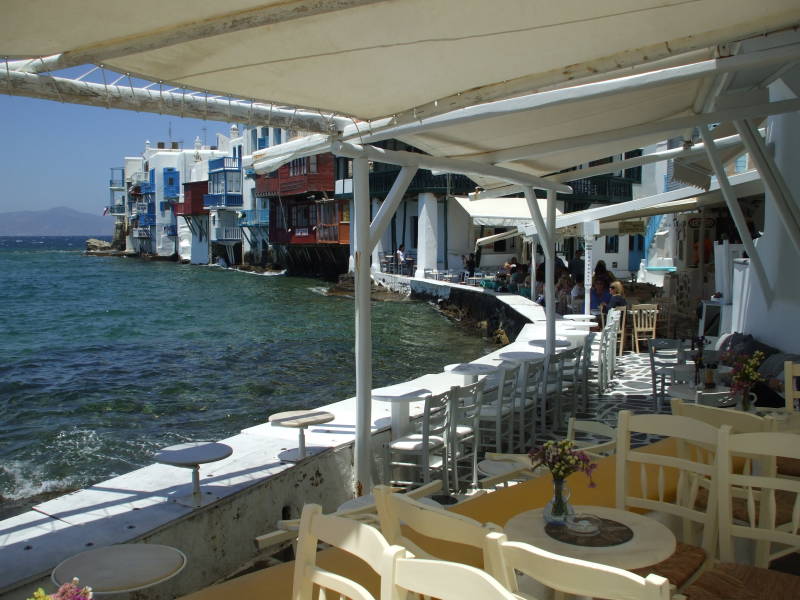
Available seating early in the day at Little Venice.
By lunch time, the tables start to fill.
Dinner on Mykonos
It gets crowded later in the afternoon. Little Venice looks out to the west, and it's a great place to watch the sunset. The fairly narrow walkway now holds dinner seating!
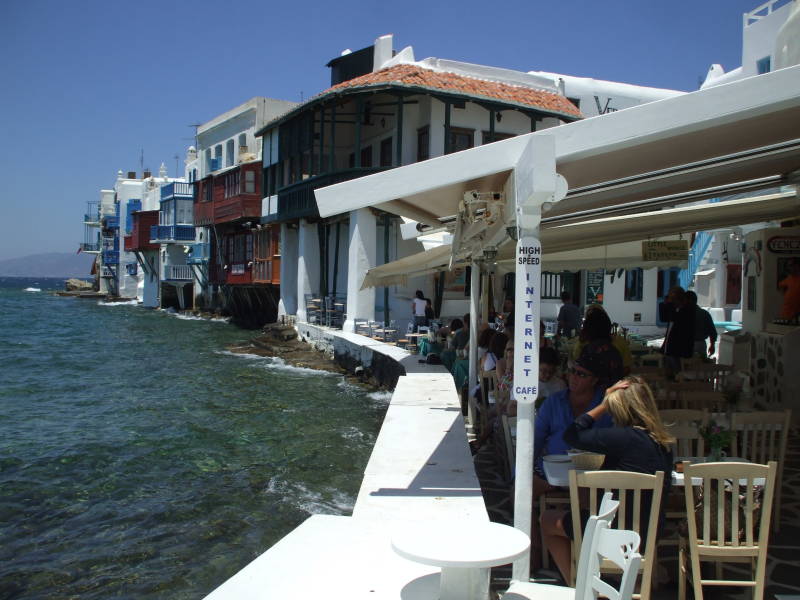
An Internet cafe with a great view!
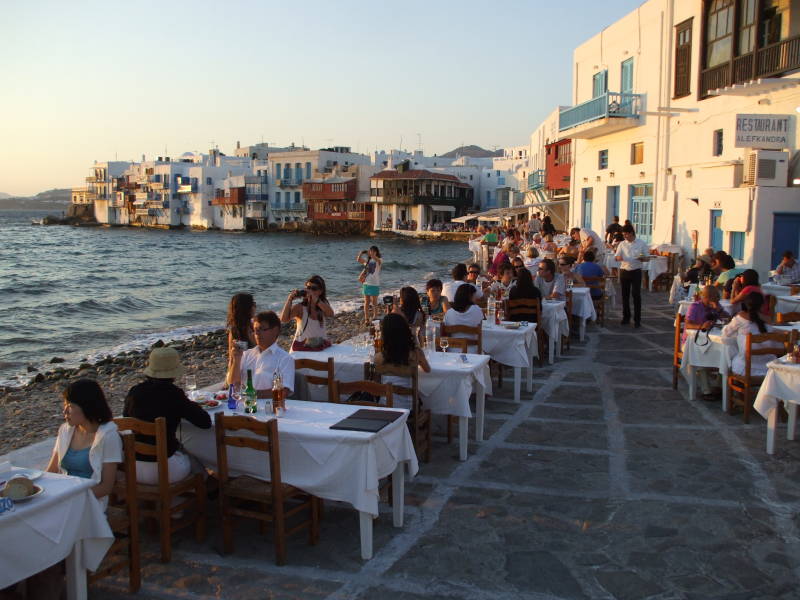
Early dinner on the waterfront in the Little Venice cafes.
The sun will set within an hour and a half, and the crowds are gathering.
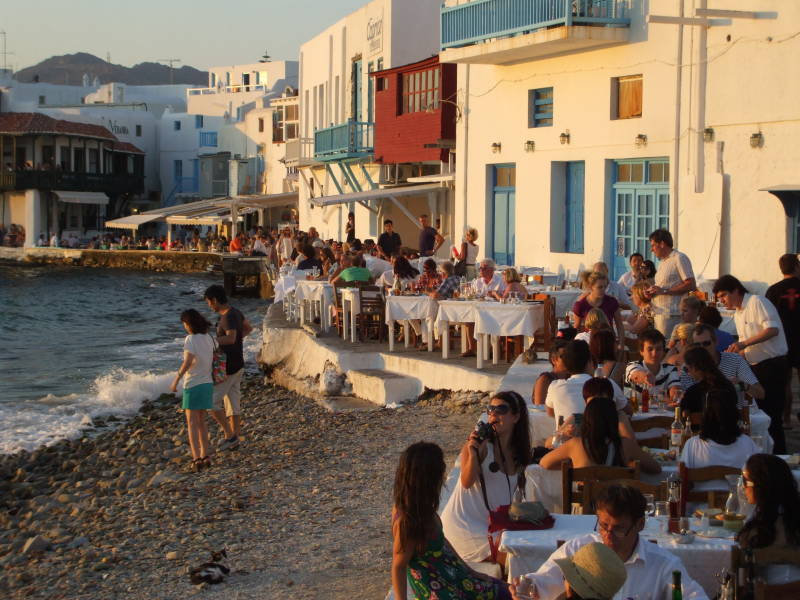
Dinner and a sunset.
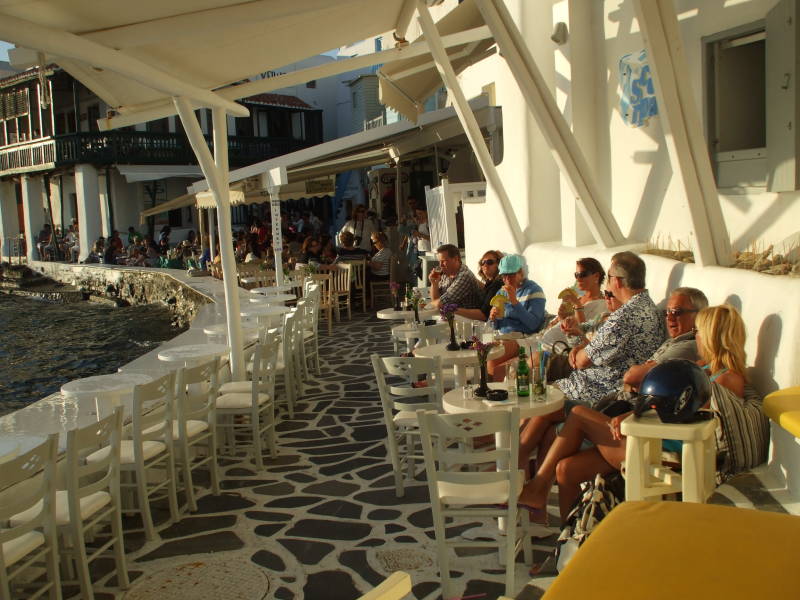
People gather in the Little Venice cafes to watch the sunset.
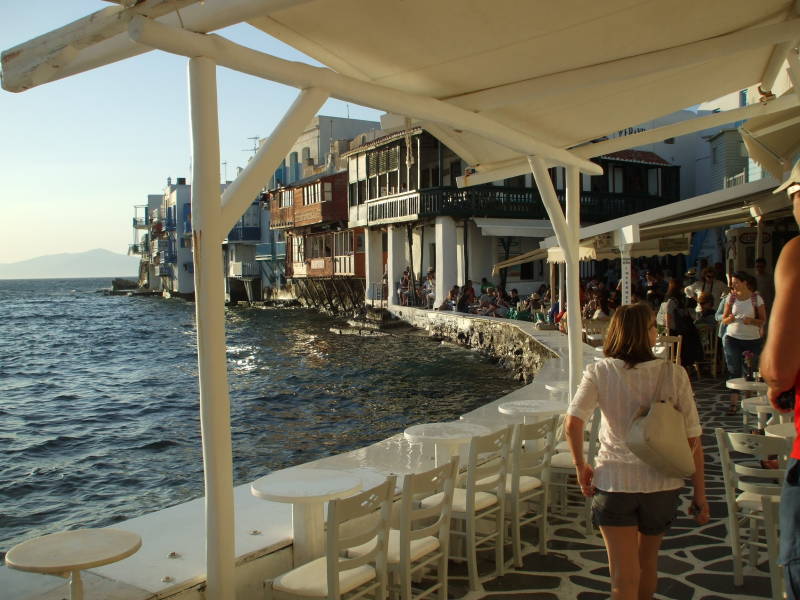
Get a seat, the sun will be setting in an hour or two.
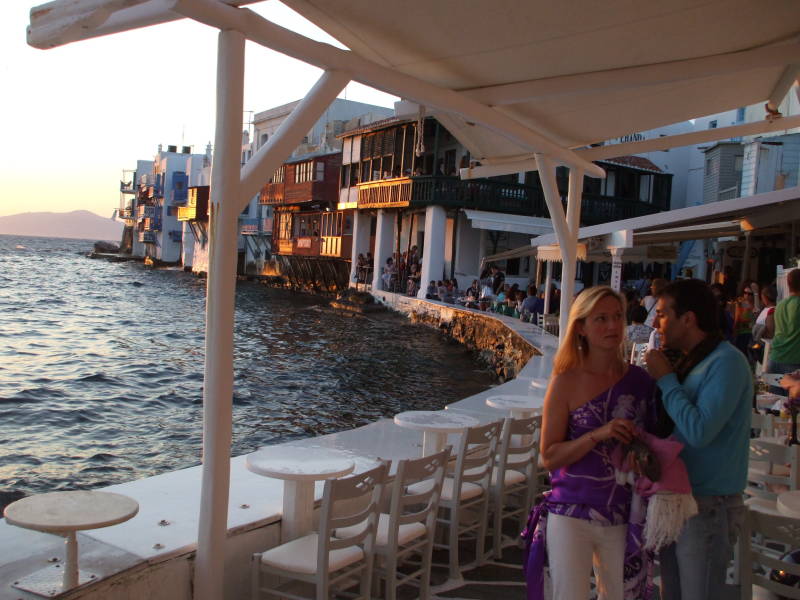
The light becomes a deeper gold as the sun approaches the horizon.
From late spring through mid-September, the sun sets to the northwest. This puts the point at which it sets toward the coast of the nearby island of Tinos.
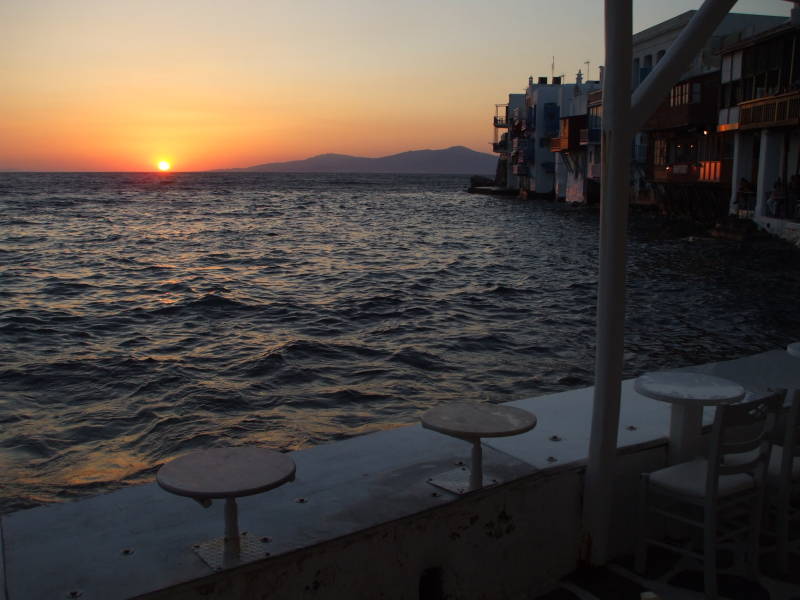
The sun sets, as seen from a Little Venice cafe on Mykonos.
Mykonos was first inhabited during the Neolithic era. Recent investigations have found remnants of settlement at Ftelia beach going back to 3000 BC.
The Ionians settled in Mykonos in the early 11th Century BCE.
Mykonos really boomed during the time that Delos was a sacred island, 900 BCE through 100 AD.
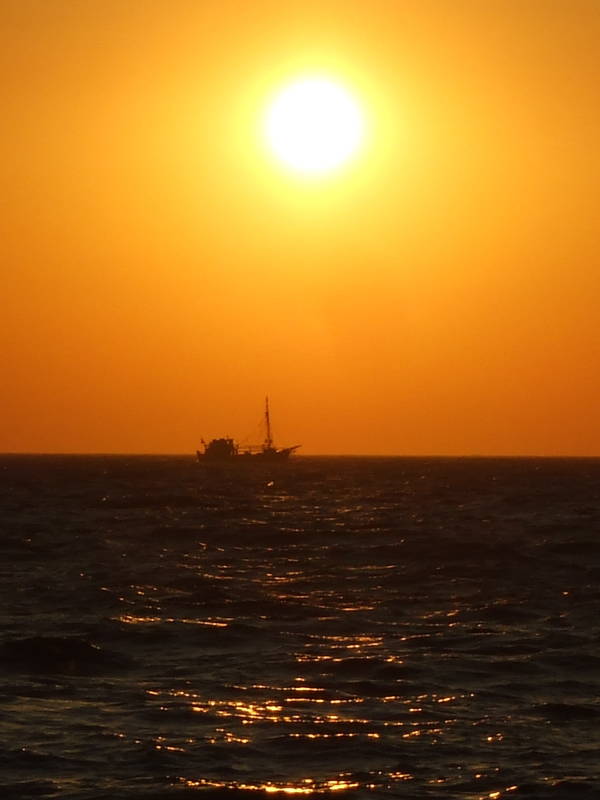
A fishing boat crosses in front of the setting sun.
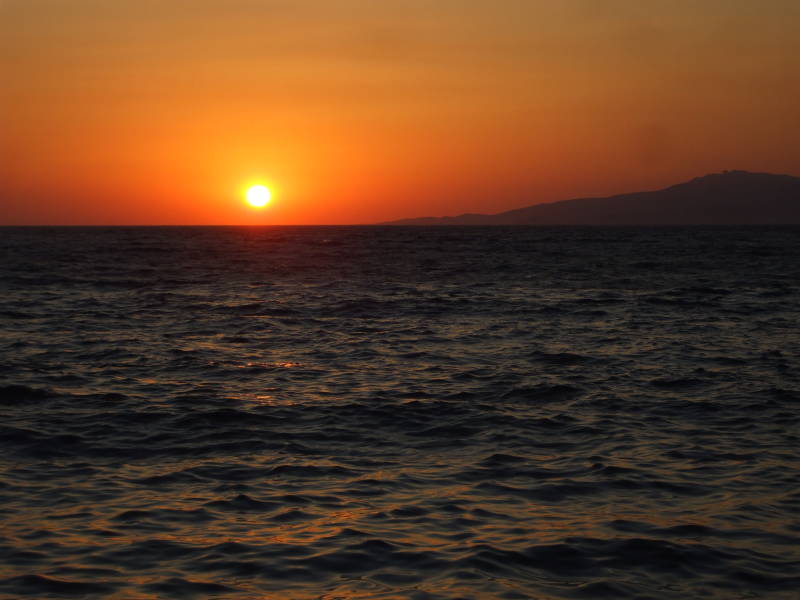
The sun sets into the Aegean near the island of Tinos, as seen from Mykonos.
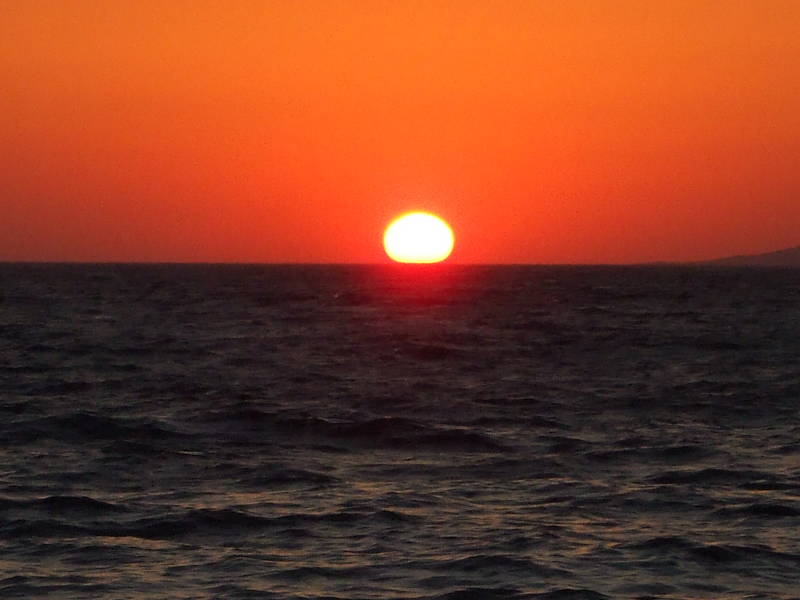
The sun sets into the Aegean near the island of Tinos, as seen from Mykonos.
The islands fell under Byzantine control, until the Fourth Crusade sacked Constantinople and the conquerors divided much of the Byzantine Empire for their own control. Venice took control of the Cyclades, forming the Duchy of Naxos. The Venetian Duke of Naxos then handed out control of various islands to his relatives and friends.
The Ottoman Turks took Constantinople in 1453, making it their new imperial capital. Hayreddin Barbarossa, the Grand Admiral of the Ottoman Navy, captured the Cyclades for the Ottoman Empire in 1537-1538 (except for Tinos, where the Venetians held out until 1715). The Ottomans largely left the administration of the islands to the existing infrastructure of Venetian noblemen.