Basics of Turkish Grammar
Pronouns & Nouns, Possession, Postpositions, Adjectives, Adverbs, Conjunctions
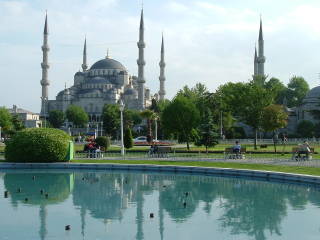
The Sultanahmet Cami (Blue Mosque) in İstanbul. See my travel page for many more pictures.
We are studying Turkish grammar, and so far we have looked at some fundamentals like the alphabet, vowel harmony, and word order. Now it's time to tackle the first class of words, the things and their modifiers. Nouns and pronouns to start with, and how they decline (or change their forms) with number and case. Then the somewhat complicated, or at least confusing, possession. Plus conjunctions, questions, comparisons, and more.
Pronouns make for a simple place to start, a little more so in Turkish than in many languages. Turkish doesn't have the needless complexity of gender, and the numbers are just one versus more than one. We have just six cases to handle, as in Russian, as opposed to the fourteen in Estonian.
There are several suffixes providing meanings -with, -without, -ish, and so on. Then the postpositions, separate words added after the word of interest, functioning like prepositions in English and creating phrases with many meanings.
Click here for this information summarized on one page!
Click here for the original LATEX
Let's get started!
Pronouns
| Absolute / Nominative |
ben | biz | I | we | |
| sen | siz | you | you | ||
| o | onlar | he / she / it | they | ||
| Accusative / Direct object |
beni | bizi | me | us | |
| seni | sizi | you | you | ||
| onu | onları | he / she / it | them | ||
| Genitive / Possessive / Owner-of, of-X |
benim | bizim | my ... | our ... | |
| senin | sizin | your ... | your ... | ||
| onun | onların | his / her / its ... | their ... | ||
| Dative / Indirect object / motion toward |
bana | bize | to me | to us | |
| sana | size | to you | to you | ||
| ona | onlara | to him / her / it | to them | ||
| Locative | bende | bizde | in me | in us | |
| sende | sizde | in you | in you | ||
| onda | onlarda | in him / her / it | in them | ||
| Ablative / comparison / motion from/through |
benden | bizden | from/than me | from/than us | |
| senden | sizden | from/than you | from/than you | ||
| ondan | onlardan | from/than him / her / it | from/than them | ||
| Demonstrative (details below) |
bu, bunlar | this, these | |||
| şu, şunlar | that, those (nearby) | ||||
| o, onlar | that, those (far away) | ||||
Note the irregularities:
- In the dative case ben and sen become bana and sana instead of the anticipated *bena and *sena.
- The plurals of ben and sen are biz and siz instead of the anticipated *benler and *senler.
- The plural of o is onlar instead of the anticipated *olar.
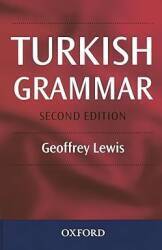
Amazon 0198700369
Amazon 0486250644
Question words
| kaç? | how much? how many? |
| ne? | what? |
| kim? | who? |
| kimin? | whose? |
| hangi? | which? |
| niçin? neden? |
why? |
| ne zaman? | when? |
| nasıl? | how? |
Nouns
Noun declension
| Case | Application | Singular | Plural |
| Absolute | nominative | — | -ler |
| Accusative | direct object | -(y)i | -leri |
| Genitive | owner-of, of-X | -(n)in | -lerin |
| Dative | indirect object, motion toward | -(y)e | -lere |
| Locative | in a place | -de | -lerde |
| Ablative | motion from | -den | -lerden |
Lewis' book distinguishes between the indefinite accusative case which uses the absolute form, and the accusative case. His examples are as follows, but his explanation is not at all clear to me...
-
Gazete çıkarmak zor bir iş.
To publish newspapers is a hard job. (absolute form) -
Bu gazeteyi çıkarmak zor bir iş.
To publish this newspaper is a hard job. (accusative form)
In the first example, Gazete is indefinite, as in a general example — Generally speaking, the publishing of newspapers is a hard job.
In the second example, Bu gazeteyi is definite, as in a very specific example — Publishing this specific newspaper is a hard job.
While the above are Lewis' examples, they might get the point across better with the following English explanations:
-
Gazete çıkarmak zor bir iş.
To publish a newspaper — any newspaper in general — is a hard job.
(indefinite or general accusative, absolute form) -
Bu gazeteyi çıkarmak zor bir iş.
To publish this newspaper is a hard job.
(definite or specific accusative, accusative form)
Noun declensions by example
| Front vowels | un-round | round | |||||||||
| house | coffee | front | roof | ||||||||
| Absolute | ev | evler | kahve | kahveler | ön | önler | örtü | örtüler | |||
| Accusative | evi | evleri | kahveyi | kahveleri | önü | önleri | örtüyü | örtüleri | |||
| Genitive | evin | evlerin | kahvenin | kahvelerin | önün | önlerin | örtünün | örtülerin | |||
| Dative | eve | evlere | kahveye | kahvelere | öne | önlere | örtüye | örtülere | |||
| Locative | evde | evlerde | kahvede | kahvelerde | önde | önlerde | örtüde | örtülerde | |||
| Ablative | evden | evlerden | kahveden | kahvelerden | önden | önlerden | örtüden | örtülerden | |||
| Back vowels | un-round | round | |||||||||
| ceiling | handle | ball | neighbor | ||||||||
| Absolute | tavan | tavanlar | kabza | kabzalar | top | toplar | komşu | komşular | |||
| Accusative | tavanı | tavanları | kabzayı | kabzaları | topu | topları | komşuyu | komşuları | |||
| Genitive | tavanın | tavanların | kabzanın | kabzaların | topun | topların | komşunun | komşuların | |||
| Dative | tavana | tavanlara | kabzaya | kabzalara | topa | toplara | komşuya | komşulara | |||
| Locative | tavanda | tavanlarda | kabzada | kabzalarda | topta | toplarda | komşuda | komşularda | |||
| Ablative | tavandan | tavanlardan | kabzadan | kabzalardan | toptan | toplardan | komşudan | komşulardan | |||
| Variable consonants |
Dog | Book | |||||||||
| Absolute | köpek | köpekler | kitap | kitaplar | |||||||
| Accusative | köpeği | köpekleri | kitabı | kitapları | |||||||
| Genitive | köpeğin | köpeklerin | kitabın | kitapların | |||||||
| Dative | köpeğe | köpeklere | kitaba | kitaplara | |||||||
| Locative | köpekte | köpeklerde | kitapta | kitaplarda | |||||||
| Ablative | köpekten | köpeklerden | kitaptan | kitaplardan | |||||||
Adjectival forms and modified nouns (sections 12.6, 15.1-2, 17.1-7; pp 83, 100, 111-114)
| -li | with or with the quality of or belonging to |
sulu = "with water" atlı = "horseman" köylü = "villager" |
| -siz | without | susuz = "without water" |
| -çi, -ci | The professional | gazeteci = "journalist", çaycı = "tea seller", dişçi = "dentist" |
| -[y]ici | The habitual | yazmak = "to write", so yazıcı = "writer" |
| -çe | -ish or as for |
çocukça = "childish[ly]" türkçe = "Turkish" bence = "as for me" |
| -(i)msi, -(i)mtrak, -si |
-ish or -like |
duvarımsı = "wall-like" beyazımtrak = "whitish" çocuksu = "child-like" |
| -daş | fellow- | okuldaş = "schoolmate" -daş does not follow vowel harmony |
| -lik | abstract noun formation | büyüklük = "largeness" or "size" susuzluk = "waterlessness" or "thirst" Granted, susuzluk is rather stilted, a Turk would more likely ask "Susadın mı?" for "Are you thirsty?" |
| -igde, -ligi | of the, similar to -lik | |
| -sel | abstract adjective formation | tarih = "history", tarihsel = "historic" |
| -ki | abstract adjective formation | sabahki hava = "morning weather" Amerikadaki çocuklar = the children in America Ahmet'inki = "Ahmet's" (with possessive) |
| -ki | added to genitive case to form a possessive pronoun | Bu kalem benim değil. = "This is not my pencil." (simple denial) Bu kalem benimki değil. = "This pencil is not mine (I do have a pencil, but this one is not it)." Bu köpek benimki. = "This dog is mine." |
| -çik, -cik, -ceğiz, -ce | Diminutive |
Ahmetçik = "my pal Ahmet" Köyceğiz = "the dear little village" and a lakeside town in southwestern Turkey. |
| -[y]iş | Add to a verb stem for the noun form |
girmek = "to enter",
so giriş = "entrance" çıkmak = "to exit", so çıkış = "exit" |
| -leyin | by or at | geceleyin = "by night" akşamleyin = "at evening" |
| -ken | while | yazarken = "while writing" |
| -oğlu | son of | Köseoğlu Bey = "Mr Son-Of-The-Beardless-Man" |
Comparison and superlatives
| Comparison | For adjectives or adverbs, use daha for "more": |
daha büyük = "bigger" (more big) daha iyi = "better" (more good) |
| For nouns, use: ablative measure |
benden büyük = "bigger than me" benden iyi = "better than me" |
|
| Superlatives | Use en for "most": | en büyük = "biggest" (most big) en iyi = "best" (most good) |
Demonstratives
| bu | this, close to the speaker |
Bu köpek benimki. This dog (sitting next to me) is mine. |
| şu | this or that, not far away |
Şu köpek benimki. That dog (across the room) is mine. |
| o | that further away |
O dağ Ağrı Dağ. That mountain (in the distance) is Mount Ararat. |
The roots bu-, şu-, o- are used to form "such X as these" phrases:
| böyle köpekler | such dogs as these |
| şöyle otobüsler | such buses as those (across the street) |
| öyle dağlar | such mountains as those (on the horizon) |
Locations
Add from/to endings to these stems to build location words:
| Stems | |
| nere- | where? |
| bura- | here |
| ora- | there |
| burada | here | orada | there | nerede? | where? | ||
| buradan | from this place | oradan | from there | nereden? | from where? | ||
| buraya | to this place | oraya | to there | nereye? | to where? |
Possession
There is what G.L. Lewis terms "indefinite" ownership, in which -i is added to the noun which is owned in a way that is not very possessive. Compare this to the more possessive "definite" version:
| Indefinite | Sultan Ahmet Camii | Sultan Ahmet Mosque | Atatürk Bulvarı | Atatürk Boulevard | ||
| Definite | Sultan Ahmed'in türbesi | Sultan Ahmet's tomb | Atatürk'ün evi | Atatürk's house |
The definite possessive is complicated, and I'm skipping details here,
but the form is:
owner(n)in ownedX
where X is replaced by:
| -(i)m | -(i)miz | owned by me | owned by us | |
| -(i)n | -(i)niz | owned by you | owned by you | |
| -(s)i | -leri | owned by it | owned by them |
So, since fil is "elephant" and ev is "house,"
filin evi means "the elephant's house", and
fillerin evleri means "the elephants' houses".
Note that you often leave off the possessor, especially when it's a
pronoun or can be derived from context.
Thus:
Filim büyük. = My elephant is big.
Bu benim büyük filim. =
Hey, this is my big elephant, get your own!
filim would mean "my elephant",
while benim filim would very adamantly make the case
that the elephant was, in fact, mine, and not anyone else's.
Sahip means "owner" or "master", and halı means "rug". Note the logic of "the owner of the rug", where the rug has an owner, and thus "rug" is the possessor (of an owner) and the owner is the thing possessed (by the rug). Thus halının sahibi for "the rug's owner".
Finally, note that çocukların bahçeleri is ambiguous, it could mean either "the garden of the children" or "the gardens of the children". It must be derived from context (about the number of gardens), or by intentionally malforming the possessed item as çocukların bahçesi to explicitly mean the one garden of the multiple children.
Postpositions (section 13.1, pp 87-89)
They work somewhat as prepositions do in English, and fall into three classes depending on the declension of the modified word.
| Class 0 — absolute |
üzere, üzre |
on yol üzere = on the road |
| Class I — ablative: -den |
başka | other than, except for bizden başka = except for us köpeklerimden başka = except for my dogs |
| beri | since, subsequent to on saatten beri = for the past 10 hours saat ondan beri = since 10:00 |
|
| bu yana | since Cumadan bu yana = since Friday |
|
| dolayı | because of Atatürk'ten dolayı, şimdi Turkiye iyi millet. Because of Atatürk, Turkey is a good country now. |
|
| önce evvel |
before, earlier than bizden önce = earlier than us saat ondan önce = before 10:00 Evvel is not originally Turkish. It used to be used more commonly during the first years of the Republic, but today önce is used more. |
|
| içeri | inside, into Kebapcıdan içeri girdik = We went into a kebap shop. |
|
| itibaren | with effect from, starting from Cumadan itibaren her gün, kebapçıdan içiri gireceğiz. Every day starting from Friday, we will go into a kebap shop. |
|
| sonra | after, later than bizden sonra = later than us saat ondan sonra = after 10:00 |
|
| Class II — dative: -(y)e |
dair | about, concerning Osmanlı tarihine dair bir kitap = A book about Ottoman history |
| doğru | straight toward Bu yol İstanbul'a doğru gitiyor. This road goes straight toward Istanbul |
|
| göre | according to Gazeteye göre, hava güzel olacak. According to the newspaper, the weather is going to be nice. |
|
| karşı | against, opposite bana karşı = against me |
|
| nazaran | compared to, in regard to Kediye nazaran filim daha büyük. = Compared to a cat, my elephant is larger. |
|
| rağmen | despite ona rağmen = despite that |
|
| Class III — genitive for these pronouns: ben, sen, o, biz, siz, bu, şu, kim absolute for all other words |
gibi | like, similar to kedi gibi = like a cat sizin gibi = like you |
| için | because of, for, for the purpose of bunun için = because of this |
|
| ile / -(y)le | with, by the kedi ile -or- kediyle = with a cat Haşhişi kilo ile satıyorum. = I sell hashish by the kilogram. |
|
| kadar | up to, until, as far as, as much as (from Arabic word for amount) saat ona kadar = until 10:00 evime kadar = as far as my house Bir saat kadar otobüse bindim. = I rode the bus for one hour. İndiana'da halk filler kadar şişman. = People in Indiana are as fat as elephants. Senin kadar zeki değilim. = I'm not as smart as you. Melek kadar güzeldi. = She was as beautiful as an angel. Cehenneme kadar yolun var! = Go to Hell! (literally You go until arriving at Hell.) Yumuşayana kadar kaynat. = Boil it until it gets soft. Hastalık Amerika'ya kadar yayılmış. = It seems the disease has spread to America. |
Other qualifiers or pronouns
| bazı, kimi | some | bazı adam, kimi adam = some man bazı adamlar, kimi adamlar = some men |
| her | every | Bu tren her gün Istanbul'a gidiyor. = This train goes to Istanbul every day. |
| biraz | a little, from az, little |
Az şarapı içerim. =
I drink little wine. Bojangels Bey dedi, "Biraz içerim". = Mr Bojangles said, "I drinks a bit". |
| kimse | whoever, or no one in the negative |
Bir kimse size arıyordu. =
Someone was looking for you. Kimse aldırış etmiyor. = No one is paying attention. |
Conjunctions
| ve | and | Evimde sıcak ve soğuk su var. | In my house there is hot and cold water | |
| veya ya da |
or | İstanbul'e veya Ankara'ya gideceğim. | I will go to Istanbul or Ankara. | |
| ki | that | Diyorlar ki olmayacak. | They are saying that it will not happen | |
| de | too, also | Biz de mi gidelim? | Shall we too go? |
Morphology, Character Shifts and Some Irregularities and Complications
Many thanks to Fatih Aygün for explaining these to me! These are his examples:
-
In most nouns ending in
-ç,
-k,
-nk
and
-p,
the last consonant
lenites
(softens or weakens) before a vowel to become
-c,
-ğ,
-ng
and
-b,
respectively.
However, this does not always happen.
The word for "tail", "queue", "follower" etc changes
as expected to form
the accusative -i/ı/ü/u:
kuyruk —> kuyruğu
but the word for "law" does not:
hukuk —> hukuku -
In some nouns the final consonant
geminates
(lengthens)
before an added vowel.
However, this does not always happen.
The word for "forgiveness" changes as expected
to form the dative -e/a:
af —> affa
but the word for "shelf" does not:
raf —> rafa -
Some nouns lose the vowel before a final consonant
when a vowel is suffixed.
The word for "breast" does when forming the accusative:
koyun —> koynu
but the identically spelled word for "sheep" does not:
koyun —> koyunu -
Sometimes that vowel loss is followed by an internal
assimilation where the consonant ending of the
previous consonant becomes hard or voiceless;
for example, the word for "transcript" or "records":
zabıt —> zaptı -
Some nouns end with a back vowel (a/ıo/u)
but take a front vowel (e/i/ö/ü) in suffixes.
The word for "left" changes as expected forming
the dative:
sol —> sola
but the identically spelled word for the musical note does not:
sol —> sole
I wonder if this may have something to do with the second of those being a rather arbitrary and borrowed "word" or really just a name. -
Some pronouns and some compound nouns formed from noun
phrases take n rather than y before
a suffixed vowel, and sometimes even before a
suffixed consonant.
The word for "army" behaves as expected forming the
accusative and nominative plural:
ordu —> orduyu
ordu —> ordular
but the word for the plant purslane formed the accusative differently than expected:
semizotu —> semizotunu
and the demonstative pronoun "this" forms both differently:
bu —> bunu
bu —> bunlar
Similarly, see the pronoun o with its plural onlar. As for the compound nouns, see the following! -
The interrogative pronoun ne or "what" is
irregular in forming the possessive:
ne —> neyim, but nem is also somewhat acceptable
and the genitive:
ne —> neyin (and not the expected *nenin)
The word for "water", su, is similarly irregular. -
There is a morphologic process of partial reduplication
to make Turkish adjectives and adverbs stronger
in meaning.
Take the beginning of the word through the first
vowel, add
m,
p,
r
or
s,
then repeat the entire adjective.
However, there is no pattern for predicting which
letter will be used (other than it's always p
if the adjective starts with a vowel),
and sometimes extra letters appear:
yeni "new" —> yepyeni "all new", "very new" yeşil "green" —> yemyeşil "all green", "very green" mavi "blue" —> masmavi "all blue", "very blue" temiz "clean" —> tertemiz "all clean", "very clean" and worse yet, plus a vowel or even a vowel-consonant pair: yalnız "alone" —> yapayalnız "all alone", "very alone" Not the expected yapyalnız çıplak "naked" —> çırılçıplak "all naked", "very naked" Not the expected çırçıplak
Now, as for those compound nouns, John Guise pointed out that the word for purslane is a compound noun made of two words that does not follow vowel harmony rules internally. Semiz (fat or meat) + ot-u (its-plant-or-grass). The second of those is already suffixed, so adding a further suffix requires a buffer letter -n- so we have semizotunu (as if it were semiz otunu) and not the expected semizotuyu. As for other examples John pointed out:
Hava + gaz became the compound havagazı (town its-gas):
- Evet, aşağı yukarı bir sene evvel havagazını açık bırakarak böyle bir iş yapmak istemişti.
-
Yes, about a year ago she had wanted to do such a
thing by leaving the town gas open.
(Cumhuriyet Gazete, possibly reporting a suicide attempt)
Hanım + el became the compound hanımelı (lady her-hand, or honeysuckle)
-
Önce bir tutam hanımelını
bir bardak su ile kısık
ateşte.
Siz hiç çocukluğunuzda hanımelını çiçeklerinin balılnı emdiniz mi?
Çiçeklerden en çok hanımelını seviyorum. -
Firstly boil a handful of honeysuckle with a
tumbler of water.
Didn't you ever suck the honeysuckle flower's nectar when you were a child?
Of (all) flowers I like the honeysuckle best.
(WWW)
Ayak + kap became the compound ayakkabı (foot its-cover, or shoe(s)):
-
Ayakkabını nasıl
bağlarsın?
Kendi ayakkabını tasarlayabilmek ne kadarda süper bir şey. -
How do you tie your shoes?
How great to be able to design your own shoes.
(WWW)
Semiz + ot became the compound semizotu (meat its-grass, or purslane).
-
Semizotunu ayıklayarak bol su ile iyice
yıkayıp üçe
bölün, dövülmüş
sarımsakları, süzme
yoğurdu, semizotunu, tuz ve
zeytinyağını bir kapta
karıştırın.
Supyalı semizotu'nu seviyorum. -
Wash the purslane thoroughly with plenty of water
and divide into three, crushed garlic, strained
yogurt, purslane, and mix in a bowl with salt and
olive oil.
I like cuttlefish with purslane.
(WWW, Ayvalık Recipe)
All these are compound nouns and the suffix and vowel harmony rules depend on the last word in the compound. Looked at that way, they are not irregular once you realize that the rules depend on the last word component. If that second word is already suffixed, then further accusative suffixes must take the buffer letter -n-. As John says, most Turks cannot explain when the buffer letter -y- is used versus -n-. For example:
-
Kediyi tekmeledim.
I kicked the cat.
Buffer letter -y- applies to a plain noun when adding the accusative -i marker. -
Kedisini tekmeledim.
I kicked his cat.
Buffer letter -n- applies to an extended (already suffixed) noun when adding the accusative -i marker.